Is Christ Enough? A Closer Look at Solus Christus
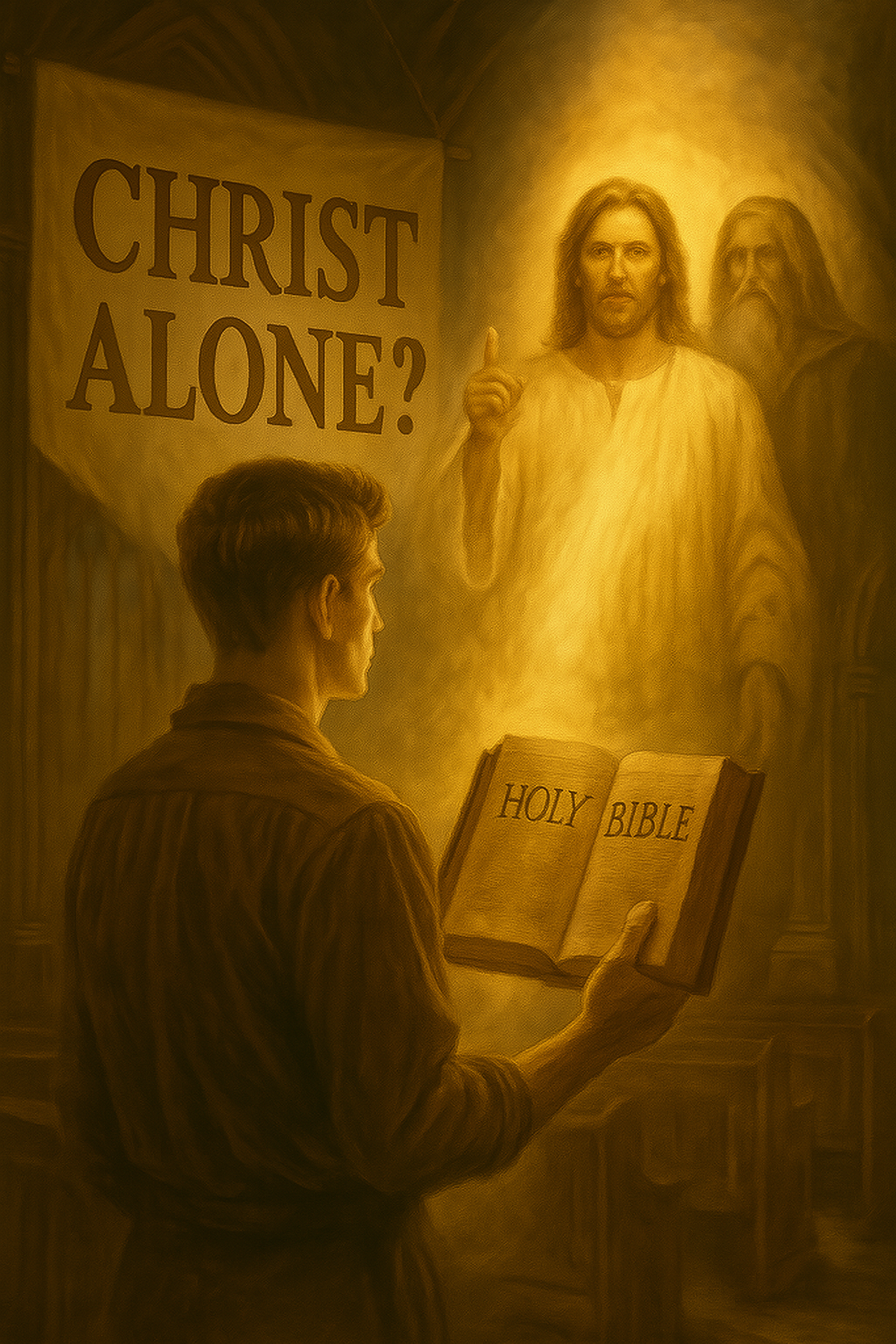
Christ alone saves — but Christ is not alone, and He never intended to be followed in isolation from the structure He Himself established.
“Christ alone” — Solus Christus — sounds beautiful, and it is. In its purest sense, it affirms that Jesus Christ is the one true Savior, the only name under heaven by which we can be saved (Acts 4:12). No Latter-day Saint would ever dispute that.
But the Reformist interpretation of Solus Christus goes beyond affirming the exclusivity of Christ’s divine role. It claims that Christ alone — with no priesthood, no church, no ordinances, no covenantal structure — is sufficient for salvation. It strips away everything else: no need for prophets, sacraments, or authorized messengers. Just Christ and the believer, alone.
But is that the gospel Christ actually gave?
The Biblical Christ Is Not a Loner
Jesus did not act in isolation. He didn’t tell His followers, “Just believe in Me, and forget the rest.” Instead, He organized a Church (Matthew 16:18), ordained apostles (John 15:16), conferred priesthood authority (Luke 9:1–2), and instituted ordinances like baptism (John 3:5), the sacrament (Luke 22:19–20), and the laying on of hands for the gift of the Holy Ghost (Acts 8:17).
He said, “He that receiveth you receiveth me” (Matthew 10:40) — meaning, to reject His authorized servants is to reject Him.
Solus Christus, as often taught, severs Christ from the very structure He Himself established. It assumes that we can receive Him without receiving His body — the Church (1 Corinthians 12:27). But Christ never intended to be followed apart from His covenant community. His gospel is not isolationist. It is incarnational, institutional, and priesthood-centered.
Christ Is the Only Way — But He Has a Way
Christ is indeed the only way to the Father (John 14:6). But that “way” includes a covenant path: faith, repentance, baptism, receiving the Holy Ghost, and enduring to the end (2 Nephi 31:17–20).
The Protestant version of Solus Christus ignores that Christ not only is the door (John 10:9), but He also built the house. He defined the ordinances, called living witnesses, gave gifts to men, and appointed leaders to guide His people (Ephesians 4:11–14). Christ never said, “Just believe and you’re done.” He said, “Come, follow me” — a journey, not a moment.
To say “Christ alone” while rejecting the path He authored is to construct a gospel of one’s own making. It is to claim the Head while denying His Body. It is to accept the King while rejecting His Kingdom.
The Danger of a Disembodied Christ
Solus Christus often becomes a subtle denial of divine order. It leads to the conclusion that no priesthood authority is needed. That sacraments are symbolic, not effectual. That churches are optional. That any individual can speak for God, interpret Scripture, or administer sacred ordinances without divine appointment.
“No man taketh this honour unto himself, but he that is called of God, as was Aaron.”
Yes, Christ is the cornerstone. But a cornerstone implies a building (Ephesians 2:20–21). Christ alone is not Christ isolated — it is Christ enthroned in the context He Himself ordained: a living Church, led by revelation, built upon apostles and prophets, bound together by covenant.
The “Priesthood of All Believers” Objection — and Its Fatal Flaw
Here is the strongest Protestant counterargument, stated in its best form: 1 Peter 2:9 declares, “But ye are a chosen generation, a royal priesthood, an holy nation, a peculiar people.” Every believer is a priest. No ordained clergy is needed. No hierarchical authority stands between the soul and God. Christ is the only mediator — full stop.
It is a confident argument. It is also demolished by a single passage.
Simon the Magician: Acts 8:9–24
Simon was a new convert. He had been baptized. He was publicly confessing Christ. Under the priesthood-of-all-believers doctrine, Simon was now a member of the “royal priesthood” — equal in authority to Peter, to John, to any other believer. That is what the doctrine requires.
When Simon witnessed Peter and John laying hands on converts to confer the gift of the Holy Ghost, he wanted that ability. He offered money for it. Peter’s response was devastating:
“Thou hast neither part nor lot in this matter: for thy heart is not right in the sight of God.”
Stop and ask the question the text forces: why couldn’t Simon confer the Holy Ghost? He was a believer. He was baptized. If 1 Peter 2:9 means every believer has equal priestly authority, Simon should have had the same standing as Peter and John. He should have been able to do exactly what they were doing.
He could not. Peter said so plainly. The text does not say Simon lacked faith. It says he had “neither part nor lot in this matter” — the word matter referring specifically to the authority to confer the Holy Ghost by the laying on of hands.
The answer is not complicated: authority is not automatic with belief. It is conferred by those who possess it. Peter and John had it. Simon did not — because no one with that authority had given it to him. His sincerity was irrelevant to the question of authorization. This single passage is the New Testament’s clearest statement that spiritual authority is not self-generated through faith. The priesthood-of-all-believers doctrine cannot survive it.
The Sons of Sceva: Acts 19:13–16
If Simon’s failure leaves any doubt, the sons of Sceva remove it. These were Jewish exorcists who invoked the name of Jesus — the correct name, the saving name, the name above all names — without having been given authority to use it. The evil spirit’s reply is one of the most arresting lines in the New Testament:
“Jesus I know, and Paul I know; but who are ye?”
The evil spirit overcame them. They fled, wounded. Knowing the name of Christ — even sincerely invoking it — does not confer authority to act in His name. Authority must be given. It cannot be assumed, purchased, or inherited by belief alone. The sons of Sceva prove that invoking Christ without commission is not faith — it is presumption.
The Verdict: Authority Flows from the Top Down
What the Gospel of Jesus Christ teaches is unambiguous: priesthood authority is conferred, not assumed. It is bestowed from above, not generated from within.
The Pattern in Scripture
- John 15:16 — “Ye have not chosen me, but I have chosen you, and ordained you.” Christ selected and ordained the Twelve — they did not ordain themselves.
- Hebrews 5:4 — No man takes this honor unto himself; he must be called of God, as was Aaron.
- Acts 9; Galatians 1 — Paul received his authority through direct divine commission and proper channels, not through personal conviction.
- Acts 8:21 — Simon, a baptized believer, was told he had “neither part nor lot” in conferring the Holy Ghost. Belief alone was not enough.
Simon’s failure is not a footnote. It is the New Testament’s clearest statement that spiritual authority is not self-generated. If the priesthood-of-all-believers doctrine were true, Peter’s rebuke makes no sense. If every baptized believer already had equal priestly standing, there was nothing Peter could withhold — and nothing for Simon to buy. The rebuke only makes sense if authority is specific, transferable by proper means, and distinctly not possessed by Simon.
God’s kingdom has always operated from the top down. Moses was called, not self-appointed. Aaron was ordained, not self-selected. The Twelve were chosen, not volunteers. And when that authority was lost from the earth through apostasy, it had to be restored — it could not simply be rediscovered by reading the text more carefully.
The Restoration: Reuniting Christ with His Church
If Christ alone saves, then His word alone must guide. And His word has always come through chosen servants, not private interpretation (2 Peter 1:20–21). He is not mute. He has not changed. He spoke to His apostles before and after His death. He continues to speak to His servants and disciples today, and will until the end of time.
The Restoration proclaims that Christ has called prophets again. He has restored priesthood authority. He has rebuilt His Church upon the same foundation He established in the meridian of time.
This is not an addition to Christ — it is His own order restored.
A Final Plea
To those who hold to Solus Christus in the tradition of the Reformers: we honor your devotion to Jesus. But we invite you to see the full picture. Christ is not asking you to reject every other voice but His — He is asking you to recognize the voices He sends.
“He that receiveth whomsoever I send receiveth me.”
“This is my doctrine… whoso buildeth upon this buildeth upon my rock.”
He never abolished covenants — He fulfilled and expanded them. He never canceled His Church — He called it again from the wilderness. He never abandoned His pattern — He restored it in power and glory.
Come to Christ. But come fully. Not to a disembodied idea, but to the living Savior who walks with prophets, empowers His priesthood, and calls His people into covenant today.
Christ alone is not alone.
He still calls. He still commands. He still covenants.
Let us follow Him — not just in spirit, but in fullness.