
Hard Sayings — When Revelation Contradicts the Book
The rule is that anything a prophet says which does not match the Bible must be rejected on the spot. Apply that rule honestly to John 6 and see who walks away.
The Rule Being Proposed
The claim usually arrives in a pair. A teaching that does not match what scripture has already said should be rejected immediately, and “a prophet told me” will not hold up when you stand before God to be judged.
Both sound careful. Both sound like a man protecting himself from deception with the only tool he trusts, and there is a real principle underneath them, one that scripture does give and that no Latter-day Saint should want to dodge. So the question is not whether testing matters. It is whether THIS is the test.
Let us not argue about it in the abstract. Take the rule exactly as stated, hand it to a first-century Jew standing in a synagogue in Capernaum, and watch what it does to him.
What Jesus Actually Commanded
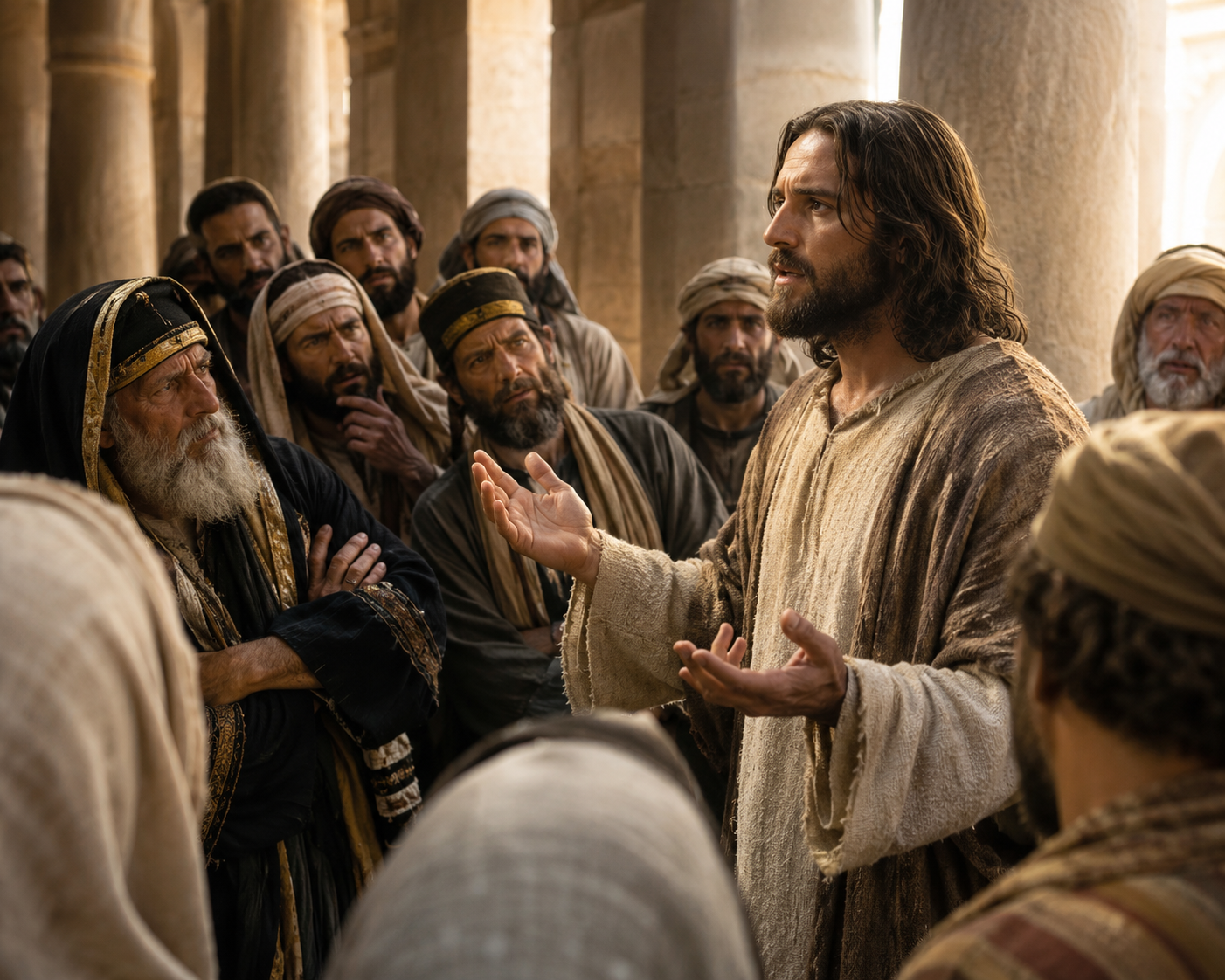
The sermon at Capernaum is the case that settles this, and it is worth reading before deciding how tolerant you would have been.
“Except ye eat the flesh of the Son of man, and drink his blood, ye have no life in you. Whoso eateth my flesh, and drinketh my blood, hath eternal life; and I will raise him up at the last day. For my flesh is meat indeed, and my blood is drink indeed. He that eateth my flesh, and drinketh my blood, dwelleth in me, and I in him.”
Modern readers hear a communion hymn. His audience heard two of the gravest prohibitions in the Law of Moses, spoken in one breath, as a requirement for eternal life.
Start with the blood. It is not a minor dietary preference and it did not begin at Sinai. It is given to Noah for all mankind in Genesis 9:4, restated as a perpetual statute in Leviticus 3:17 and 7:26–27, and repeated with unusual force in Deuteronomy 12:16, 23–25. The penalty attached to it is not a fine.
“I will even set my face against that soul that eateth blood, and will cut him off from among his people. For the life of the flesh is in the blood.”
That is the formula the rabbis called karet — excision, being cut off from the covenant people. God sets His face against you. Is that a dietary quibble? Whatever else the men in that synagogue were, they were not squeamish nitpickers, and they were not inventing an objection to avoid a teacher they already disliked.
Now the flesh. In the Hebrew Bible, eating human flesh appears almost nowhere except as covenant curse and siege horror. It is the threatened judgment of Leviticus 26:29 and Deuteronomy 28:53–57. It is what Jeremiah says will happen to Jerusalem in Jeremiah 19:9, what Lamentations records actually happening in Lamentations 4:10, what Ezekiel foretells in Ezekiel 5:10, and what two starving mothers do during the siege of Samaria in 2 Kings 6:28–29.
So put the two together the way they heard them. Break the blood law, which carries excision, and then do the thing that scripture describes only as what happens to a city God has abandoned. Their reaction in verse 52 is not stupidity. It is LITERACY.
He Escalated Instead of Softening
The detail that decides the case lives in the Greek, and most English readers walk straight past it.
Through verses 50–53 the verb is phagein, the ordinary word for eating. Beginning at verse 54, and again in 56, 57, and 58, John switches to trōgō, a coarser and more physical word that sits closer to gnawing or chewing, the verb you would reach for to describe an animal at a trough. The objection lands in verse 52, and the language immediately gets more graphic rather than less.
Why would a teacher who had simply been misunderstood do that? Any answer that has Jesus merely tripping over a metaphor has to explain the verb change, because it happens precisely at the point of offense.
The murmuring in verse 60 uses sklēros. That word does not mean confusing. It means harsh, offensive, hard to stomach. They were not saying they could not follow the metaphor. They were saying they could not ACCEPT it.
And He let them go. There is no clarification anywhere in the chapter, no “of course I meant this symbolically,” no footnote offered to the offended, and no messenger sent after them. Verse 63 tells them the words He speaks are spirit and life, which is a statement about where His teaching comes from, not a retraction of what it said. Then comes the verse the whole chapter has been aiming at.
“From that time many of his disciples went back, and walked no more with him.”
DISCIPLES. Not hecklers, not Pharisees sent from Jerusalem to trap Him, but men who had been walking with Him and who had watched Him feed five thousand people the day before. They heard a teaching that contradicted the written word of God, they measured it against the book exactly as instructed, and they left. Nobody chased them down the road with an explanation.
Now Run the Rule on Him
The rule says that a teaching which does not match prior scripture must be rejected on the spot. Apply it to Capernaum without flinching.
The teaching contradicted the written law. The teacher declined to reconcile it. He then said it four more times in stronger language. Under the proposed rule those men who walked away in verse 66 were not being stubborn at all — they were OBEDIENT. They ran the exact test the argument recommends, they got the answer the test was built to produce, and they used it to walk out on the Son of God.
If that is where your rule lands you, what does that say about the rule? The prophet is not the thing that broke.
And the second half of the argument dies in the same verse. Which of those men will stand at the judgment and plead that the text was clear, that the law was on their side, that nobody ever explained it to them? Every one of those pleas is TRUE. The written word did back them up, it was not enough, and the Lord never once suggested that it would be.
What Peter Did Instead
The Twelve got the same sermon. They had the same scriptures, the same law, the same horror at the words. Jesus turned and offered them the door.
“Then said Jesus unto the twelve, Will ye also go away? Then Simon Peter answered him, Lord, to whom shall we go? thou hast the words of eternal life. And we believe and are sure that thou art that Christ, the Son of the living God.”
Read what Peter did not say. He did not claim the teaching squared with Leviticus, he did not produce a harmonisation, and he never pretended to understand the saying, because he plainly did not understand it any better than the men leaving.
What he had was a prior WITNESS about the man doing the speaking. He knew who Christ was, he knew where the words of eternal life came from, and he was willing to carry an unresolved teaching for as long as that took. There is the whole difference between the Twelve and the men on the road home.
Both groups held the same book. Which of them had asked God about the messenger?
The Explanation Came Much Later
The resolution everyone now takes for granted did not arrive that afternoon. It came about a year later, in an upper room, on the night of the betrayal.
At the Last Supper the bread is broken and the cup is passed, and the saying finally has a shape a disciple can hold — body and blood as emblems of an atoning sacrifice and of a covenant that binds us to Him (Matthew 26:26–28; Luke 22:19–20). Paul is still unfolding it decades afterward in 1 Corinthians 11:23–29.
A YEAR. That is the gap between the command and the explanation, and every disciple who insisted on understanding before obeying spent the whole of it outside.
One more detail is worth having. The blood prohibition did not quietly evaporate once Christ rose from the tomb, because the apostolic council at Jerusalem deliberately kept it on the Gentile converts in Acts 15:20, 29. So was the scruple those disciples felt ever dismissed as ignorance? Their law was real, their reading of it was competent, and they still arrived at the wrong answer.
Being right about the text is not the same thing as being right.
Almost Every Prophet Fails This Test
Capernaum is not an isolated case. Once you notice the pattern you cannot open the Bible without tripping over it.
Abraham is commanded to kill his son. Human sacrifice is the signature abomination of every nation around him, and the command also cancels the covenant promise God had made through that same boy only a few chapters earlier (Genesis 22:1–2). How much explanation is offered in advance? NONE.
Moses is told to cast a bronze serpent and mount it on a pole so that the dying can look at it and live (Numbers 21:8–9). Read that against the second commandment, and against the golden calf the man had recently ground to powder. Israelites DIED in that camp because they would not raise their eyes to an object the written law appeared to forbid, and centuries afterward Christ took that same serpent and made it a type of Himself (John 3:14–15).
Hosea is told to marry a harlot (Hosea 1:2). Isaiah is told to walk stripped and barefoot for three years as a sign (Isaiah 20:2–4). Ezekiel is told to bake his bread over human dung, protests that nothing unclean has ever entered his mouth, and is granted cow dung instead — a prophet objecting from the law and God accommodating him without withdrawing the sign (Ezekiel 4:12–15).
Then there is Peter on the rooftop, who runs the critic’s rule out loud and gets corrected for it:
“Not so, Lord; for I have never eaten any thing that is common or unclean. And the voice spake unto him again the second time, What God hath cleansed, that call not thou common.”
Peter quotes the written law back to God and God overrules him. The vision had to be repeated three separate times before the chief apostle would accept new revelation that cut against a text he had kept faithfully his entire life.
And the largest example is the one nobody counts. Circumcision is called an everlasting covenant in the flesh in Genesis 17:13–14, with excision named as the penalty for the uncircumcised male, and a council of living apostles set it aside for the Gentiles in Acts 15. Every Protestant reading this page accepts that decision. On what basis? On exactly one: that living apostles, guided by the Holy Ghost, may deliver what the standing text does not contain.
So the rule is not actually held by the people who recite it. It gets enforced against Joseph Smith and suspended for the book of Acts.
What Scripture Puts at the Judgment
The second claim deserves a straight answer. Will “a prophet said so” hold up before God?
Search the whole record for a single soul condemned at the judgment for having believed a true prophet. Where is he? There is no such person anywhere in scripture, and the judgments that are recorded run the other direction every time.
A generation drowned for disregarding Noah. Jerusalem burned after refusing Jeremiah. Christ’s own charge against the city is that it killed the prophets and stoned those who were sent to it (Matthew 23:37). Jehoshaphat puts the principle in a single line: “Believe in the Lord your God, so shall ye be established; believe his prophets, so shall ye prosper” (2 Chronicles 20:20).
“He that heareth you heareth me; and he that despiseth you despiseth me; and he that despiseth me despiseth him that sent me.”
Jesus said that about MEN. Fishermen, a tax collector, and a handful of others with no perfect record among them, one of whom would deny Him three times before the week was out. He tied your reception of the Father to how you treat the messengers, and He said it again in Matthew 10:40–41.
Amos supplies the reason underneath it. God does nothing without revealing it to His servants the prophets (Amos 3:7). Take that verse seriously and the messenger stops looking like an obstacle standing between you and God. He is the appointed route to Him.
The Test God Actually Gave
None of this asks anyone to switch off his judgment, and the Restoration never has. Scripture does supply tests. They are simply not the test being proposed.
Deuteronomy 13:1–3 gives one: a prophet is false if he calls you after other gods, and that holds even if his sign comes to pass. Deuteronomy 18:21–22 gives another. Christ gives a third in Matthew 7:15–20, which is fruit. John gives a fourth in 1 John 4:1–3, and it is whether Christ is confessed come in the flesh.
Notice what is missing from all four of them. Which one asks whether the teaching already appears in the text you happen to possess? Had that been the standard, the canon would have closed with Malachi, and the New Testament would never have been written at all.
The Restoration adds the test Peter was working from, and makes it available to everyone. Ask God yourself. Moroni 10:4–5 puts the book directly in front of the Holy Ghost, and D&C 9:8–9 requires you to study it out in your own mind before you ask.
That is a heavier assignment than checking a concordance, not a lighter one. It cannot be done by proxy and it cannot be faked.
The Verdict
The rule fails on its first serious test, and it fails against Christ.
In John 6 the Lord gave a command that broke a standing law carrying a penalty of excision, evoked the worst curse language in the Hebrew Bible, refused to soften a word of it, reached for a coarser verb the moment He was challenged, and then watched disciples walk away rather than explain Himself to them. Anyone applying “reject whatever does not match the book” that afternoon would have left with them, and could have quoted chapter and verse the entire way home.
The second claim collapses beside the first. Scripture never once condemns a soul for heeding God’s servants, and it condemns city after city for refusing them. “A prophet said so” is no flimsy excuse. It is close to the whole reason God sends one.
What does the rule really protect? A canon that can never be added to is a God who has stopped speaking, and the man holding that position has guaranteed that no revelation will ever surprise him again. He arranged it that way himself.
Peter had no better information than the men who left. He had a witness, he had loyalty to the man who held the words of eternal life, and he was willing to wait a year in the dark for the meaning of a saying that horrified him. He got it in an upper room, and Christians have been eating that bread every week since.
So which disciple are you in that chapter? That is the only question John 6 was ever asking, and it has not changed.
Related
Follow the Argument Further
- Test All Things — the Bereans, Paul, and John, with the surrounding verses left in
- Prophets Don’t Have to Be Perfect — the standard no biblical prophet could meet
- Sola Scriptura Refuted — the doctrine that makes this rule seem obvious
- Why God Requires Belief Before Evidence — the order revelation actually comes in
- How to Receive Truth — the pattern Peter was already using
- The Gates of Hell and Continuous Revelation — why the canon was never sealed
- Abraham’s Test — a command with no explanation attached
Citation Traps
- John 6:63 as a retraction — “the flesh profiteth nothing” is read as Jesus admitting He spoke symbolically. His hearers did not take it that way, He did not correct them, and verse 66 is what happened next.
- Treating verse 60 as confusion — sklēros means offensive, not unclear. They understood Him well enough to be scandalised.
- Acts 15 quietly exempted — setting aside an “everlasting” covenant of circumcision is the same act being condemned when a latter-day prophet does it.
- Deuteronomy 13 as a canon test — the actual criterion is idolatry, not novelty. A prophet is condemned there for pointing you to other gods, never for teaching something new.