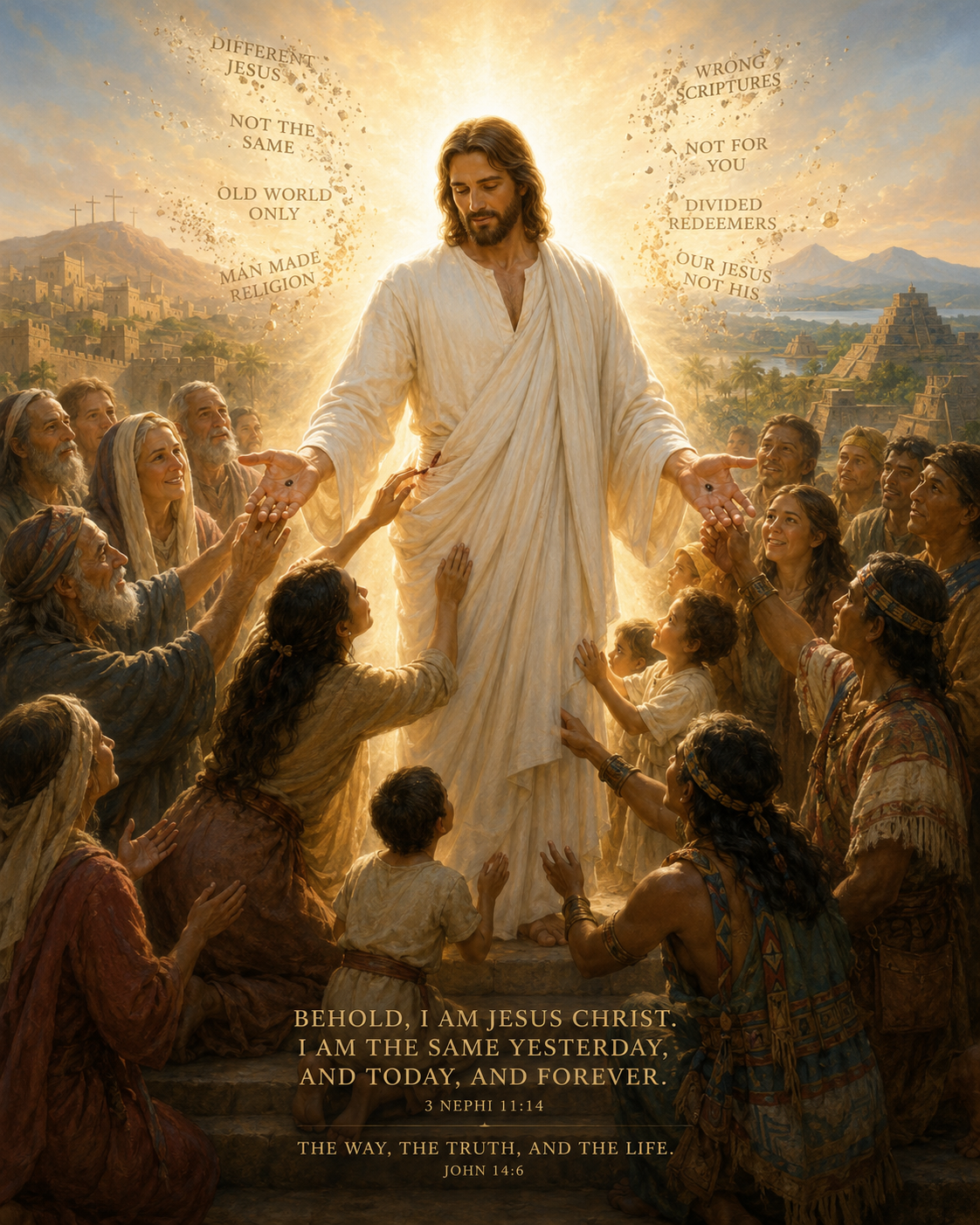
Is the LDS Jesus the Jesus of the Bible?
The charge that Latter-day Saints worship a “different Jesus” collapses the moment Scripture is allowed to define who Jesus actually is — and it collapses again when the critic is pressed to defend the metaphysics he is hiding behind.
The Charge
“You don’t believe in the same Jesus we do.” It is the most common opening salvo in evangelical attacks on the Latter-day Saint faith. The accusation is engineered to disqualify — to remove Latter-day Saints from the Christian conversation entirely by asserting that the Christ they testify of is a fundamentally different figure from the Christ of the New Testament.
The charge is loaded, repeated, and false.
It is loaded because it presumes the accuser owns the definition of who Jesus is. It is repeated because it has rhetorical force regardless of evidence. And it is false because the moment Scripture is allowed to define who Jesus actually is — not creeds composed centuries after the apostles, not a sixteenth-century Reformed systematic theology, not the talking points of one evangelical tradition — the LDS Jesus and the biblical Jesus are revealed to be the same Christ. The same Person. The same Lord. The same Savior of the world.
This article does not flinch from the hardest forms of the objection. The lazy version — “Mormons believe X” — is answered easily and answered below. But the serious critic does not lead with caricature. He leads with metaphysics: he concedes the surface match and then argues that the category of deity itself differs, so that no amount of attribute-matching can close the gap. That argument is met head-on here, not dodged. It is the strongest card the critic holds, and it does not win the hand.
Letting Scripture Define the Biblical Jesus
Before any comparison can be made, the biblical witness has to be laid out plainly. Who, according to the Bible itself, is Jesus Christ? Not according to Nicaea. Not according to Chalcedon. Not according to Westminster. According to the apostles who actually walked with Him.
Who Is Jesus Christ — The Biblical Witness
That is the Jesus of the Bible. Every point is plain, repeated, and load-bearing in the New Testament. The honest question now is not whether someone in modernity uses different vocabulary — it is whether the Christ they confess matches this Christ. Latter-day Saints will now match Him point for point, with Scripture and revelation behind every line.
What Latter-day Saints Affirm About Jesus Christ
Latter-day Saints affirm every single point above. Not approximately. Not in part. Every one. And on many of them, the LDS position is more biblically full than the position of the critic making the charge.
2 Nephi 25:26
“And we talk of Christ, we rejoice in Christ, we preach of Christ, we prophesy of Christ, and we write according to our prophecies, that our children may know to what source they may look for a remission of their sins.”
The eternal Son of God. Christ is the eternal, divine Son of God the Father. He is not created out of nothing at a point in time. He is the Word who was with God in the beginning, and who was God (D&C 93:21; cf. John 1:1). What “eternal” means on Latter-day Saint premises — and why it makes Him God and not merely ancient — is taken up directly below, because the honest critic presses exactly there.
The Creator of all things. The heavens and earth were created by Jesus Christ, under the direction of the Father (Mosiah 3:8; D&C 76:24; Hebrews 1:2). “All things were made by him; and without him was not any thing made that was made” (John 1:3).
Jehovah, the God of the Old Testament. Latter-day Saints teach this more clearly than almost any other Christian tradition: the God who appeared to Moses in the burning bush, gave the Law at Sinai, and was prophesied by Isaiah was Jesus Christ in His pre-mortal divinity. Christ Himself claimed the name: “Before Abraham was, I AM” (John 8:58) — the divine Name from Exodus 3:14.
Born of a virgin. Mary was a virgin. The Holy Ghost overshadowed her. The child conceived in her was the Son of God (Luke 1:34–35; Alma 7:10; Mosiah 3:8).
Without sin. He did no sin (Hebrews 4:15; 1 Peter 2:22; D&C 45:4). The Book of Mormon makes Christ’s sinlessness the linchpin of His power to atone (Mosiah 14–15; Helaman 5:9).
Atoned for the sins of the world. Latter-day Saints affirm the substitutionary, infinite, world-encompassing atonement of Jesus Christ (Alma 7:11–13; Mosiah 3:7; D&C 19:16–19). His blood was shed in Gethsemane (Luke 22:44) and on the cross (John 19:34) — both, not either-or.
Crucified, died, and buried. The cross was real. The death was real. The burial was real. The Book of Mormon prophesied the crucifixion in detail centuries before it occurred (1 Nephi 11:33; Mosiah 3:9; 3 Nephi 11:14).
Rose bodily from the dead. He rose in real flesh and bone — “A spirit hath not flesh and bones, as ye see me have” (Luke 24:39). The risen Christ then let 2,500 men, women, and children individually feel the wounds in His hands, feet, and side (3 Nephi 11:14–15). No tradition takes the bodily resurrection more seriously than the Restored Gospel.
Ascended into heaven. He rose visibly, and He will return visibly (Acts 1:9–11; 3 Nephi 26:15; D&C 88:95–98).
The only name by which any soul may be saved. Latter-day Saints affirm Acts 4:12 in its most absolute form. Not in Joseph Smith’s name. Not in the Church’s name. Only in the name of Jesus Christ (Mosiah 3:17; 2 Nephi 31:21; D&C 18:23).
Worshiped as God. Latter-day Saints worship Jesus Christ — sing to Him, pray in His name, take His name in baptism, renew that covenant weekly, build temples to Him, name their faith after Him, and hope to dwell with Him eternally.
Will return in glory to judge. He will return. He will judge the nations. Every knee will bow and every tongue will confess (D&C 88:104; Mosiah 27:31; Philippians 2:10–11).
Examine the list and identify a single attribute the Bible gives to Jesus that the Latter-day Saint denies. There is not one. And that fact forces the serious critic to abandon the attribute level entirely and retreat to the level of category. That retreat is where the real argument is — so that is where we go.
The Ontology vs. Function Objection — and What It Actually Proves
The most sophisticated form of the “different Jesus” charge concedes the surface match. Yes, the informed critic admits, Latter-day Saints affirm the same works of Christ. But, he insists, this is merely functional agreement. The real question is ontological: is the LDS Jesus consubstantial with the Father in the Nicene sense — of one ousia, one substance? If not, then matching Him on works is a counterfeit.
Two distinct things hide inside that objection, and they must be separated, because the standard LDS reply answers only one of them.
First, the epistemic question: how is the true Christ recognized? Here the apostles are explicit, and they never name metaphysical substance as the test.
John 20:31
“But these are written, that ye might believe that Jesus is the Christ, the Son of God; and that believing ye might have life through his name.”
John, writing the most theologically rich Gospel, names the criterion for recognizing Christ: signs, works, testimony. He never asks the reader to verify substance metaphysics.
Matthew 16:15–17
“…Thou art the Christ, the Son of the living God. And Jesus answered… Blessed art thou, Simon Bar-jona: for flesh and blood hath not revealed it unto thee, but my Father which is in heaven.”
The foundational confession of the Church is a revelation-based recognition, expressly not a product of category analysis. The test of the true Christ is the witness of the Spirit.
1 John 4:2–3
“Every spirit that confesseth that Jesus Christ is come in the flesh is of God…”
This is a real, Spirit-given criterion — and Latter-day Saints pass it in its most literal form. But honesty requires precision about what it proves. John wrote against the Docetists, who denied that Christ came in real flesh; the incarnation test is therefore a necessary condition for true confession, not a sufficient one. Affirming the incarnation does not by itself certify every further claim — other groups affirm it too. So 1 John 4:2 is best stated not as the test that ends the conversation, but as a test the critic’s own Christ must also pass, and which exposes that the apostolic criteria are about witness and incarnation, not homoousios.
Second, the identity question: is the recognized Christ the same Christ? This is the question the epistemic answer does not, by itself, settle — and the honest apologist should say so plainly. Showing that one can find Christ without Nicene metaphysics is not yet showing that the Christ one finds is identical to the Christ of the apostles. That identity has to be argued on its own, and it is argued in everything that follows: same Person (the pre-mortal Jehovah, John 8:58), same incarnation, same atonement, same bodily resurrection, same return, same exclusive saving name. The identity is established by the convergence of the whole biblical witness, not by a single proof text.
What the ontology objection actually proves, then, is narrower than the critic thinks. It proves that the critic’s real authority is not the bare text of Scripture but a particular metaphysical reading of Scripture, developed three centuries after Christ, which he has installed as the test of orthodoxy. He is welcome to that reading. He is not welcome to claim it is the Bible, while treating the apostles’ own stated criteria — witness, works, incarnation, the Spirit’s confession — as insufficient. When he insists ontology must trump these, he is elevating Nicaea above the New Testament. That is precisely the elevation of post-apostolic tradition over Scripture that the Reformation claimed to refuse.
The Genus Objection — “Your God Was Once a Man”
Here is the deepest form of the charge, and the one the lazy apologist never sees coming. The serious critic does not stay at the level of Christ’s attributes. He goes up one level — to the category of deity itself — and says:
The Critic’s Strongest Argument
“Latter-day Saint doctrine teaches that God the Father is an exalted Man who progressed to Godhood. Lorenzo Snow’s couplet — ‘As man now is, God once was; as God now is, man may be.’ The King Follett discourse — ‘God himself was once as we are now.’ If the Father is a graduate of someone else’s plan of salvation, then your God is a kind of being the Bible’s God is not. The God of Exodus 3:14 is the self-existent ‘I AM.’ The God of Isaiah is ‘the first and the last,’ underived, without origin. Your Father has an origin. And the Son of a once-mortal God is the Son of a different kind of God — so He is a different kind of Son. Your attribute-matching never touches this, because the difference is not in the attributes. It is in the genus.”
This is the real argument. It deserves a real answer, and the answer is not to deny the doctrine but to deny the implication the critic smuggles into it.
First, the doctrine stated honestly. Latter-day Saints do affirm that the Father is an exalted, embodied, personal Being, and that there is a relationship between His glory and the path of exaltation. We do not pretend otherwise, and the apologist who tries to hide the King Follett material forfeits his credibility the moment the critic produces it. So state it plainly: we affirm an exalted Father.
Second, the implication denied. What the critic needs is not the doctrine but the inference — that an exalted Father cannot be the true, sufficient, absolute object of worship the Bible describes. That inference does not follow, and Scripture itself refuses it.
Consider what the Bible actually requires of God as the object of worship. It requires that He be the only God we worship (Exodus 20:3), the Creator of all that is in our cosmos (Isaiah 44:24 within its covenant frame), omnipotent and omniscient relative to us, the source of our salvation, eternal and unchanging in His perfection (Malachi 3:6 — “I am the Lord, I change not,” spoken of His covenant faithfulness and moral constancy), and the final authority before whom every knee bows. Every one of these the Latter-day Saint affirms of the Father without reservation. He is our God — the God of this creation, the Father of our spirits, the Author of our salvation, perfect, unchanging in righteousness, supreme, worshiped, final. Nothing in the doctrine of His exaltation subtracts a single one of these from Him for us.
The critic’s objection therefore reduces to a claim about God’s biography prior to and outside our economy — and Scripture is conspicuously silent there. The Bible nowhere takes up the question the critic insists is decisive. It reveals God as He stands toward us: absolute, sufficient, supreme, eternal in His Godhood relative to His creation. It does not deliver a treatise on the conditions of the divine nature in eternities outside our knowledge — and where Scripture is silent, the critic cannot manufacture a disqualification and call it the Bible’s.
Third, aseity. The critic’s strongest single word is aseity — self-existence, the Name “I AM.” Does eternal progression destroy it? No — it relocates it from substance to intelligence. As shown in the next section, the irreducible core of God’s being — His eternal intelligence — is uncreated, underived, without origin (D&C 93:29). The Father did not come into existence. There was no point at which He was not. What “progressed” is the fulness of His glory and exaltation, not the bare fact of His existence. So the “I AM” — the self-existence that the Name guards — is preserved at the level Scripture actually guards it: God’s being is underived. He was always.
So the genus objection, pressed to its root, is a demand that Latter-day Saints affirm a specific philosophical theory of the divine nature — classical divine simplicity and absolute timeless aseity of substance — as the condition of worshiping the “real” God. That theory is Greek before it is biblical. The God of the burning bush is self-existent and supreme; He is not thereby a metaphysical simple without parts, passions, or relations. When the critic insists otherwise, he has once again named his true authority, and it is not Moses.
We affirm the doctrine. We deny it makes the Father a lesser object of worship, and we deny that Scripture authorizes the inference. The honest LDS position is exactly this: an exalted Father who is, for us and forever, the absolute, sufficient, unchanging, supreme God — and whose Son is therefore not a lesser Christ, but the divine Son of the only God we will ever know, worship, or stand before.
The Eternality Question — What Makes Christ God
The critic has a sharp follow-up, and it is the best technical objection in the whole exchange:
The Co-Eternality Trap
“You say Christ is co-eternal with the Father because His intelligence was never created (D&C 93:29). But that verse makes every human intelligence co-eternal — ‘Man was also in the beginning with God.’ So ‘co-eternal’ is true of Christ and equally true of me. In classical theism, eternal self-existence is the Creator–creature boundary marker — the thing that makes God God. If everyone has it, it no longer marks Christ as divine. Your Jesus is eternal in exactly the sense I am eternal. So His eternality doesn’t make Him God. It makes Him like me.”
This is a serious objection and it must be answered on its own terms, not waved away.
The answer is that eternality is not, in Latter-day Saint theology, the thing that constitutes deity — and it was never claimed to be. The critic is assuming a framework (classical theism, where uncreated self-existence is the sole and sufficient mark of God) and then charging LDS doctrine with failing inside that framework. But LDS doctrine does not locate Christ’s divinity in bare eternality. It locates it elsewhere, in things that are not universally shared:
What Actually Makes Christ God
- Office and appointment. Christ is the Firstborn, foreordained and anointed as the Redeemer (D&C 93:21; 1 Peter 1:20). No other intelligence holds that office.
- Fulness of glory and divine nature. “He received a fulness of the glory of the Father… he received all power, both in heaven and on earth” (D&C 93:16–17). The other co-eternal intelligences did not. Christ alone, of the spirit children, possessed the divine fulness — “in him dwelleth all the fulness of the Godhead bodily” (Colossians 2:9).
- Creatorship. By Him were all things made (John 1:3; Colossians 1:16). The created order is His work, not the work of a fellow creature.
- Sinlessness and atoning sufficiency. He alone was without sin and able to make an infinite atonement (Mosiah 14–15; Hebrews 4:15).
- Sonship and unity with the Father. He is one with the Father in mind, will, glory, and power (John 17:21–22), the express image of His person (Hebrews 1:3).
Bare eternality, on this view, is the substrate of all personal beings, not the crown of deity. The critic mistook the floor for the throne. That every intelligence is uncreated no more dissolves Christ’s divinity than the shared humanity of all men dissolves the unique kingship of a rightful king. What makes Christ God is not that He existed — it is who He is, what fulness He holds, what He has done, and His unity with the Father. On every one of those, He stands utterly alone.
Now the harder half — the relation. The critic presses again: “Fine, but the Father–Son relation still has a beginning. If the spirit-birth is when Christ’s spirit body is organized, then Christ-as-Son began, even if Christ-as-intelligence did not. You’ve relocated Arianism from the substance to the relation. ‘I was in the beginning with the Father’ can mean the intelligence, not the Son.”
Two responses, and the first is the stronger.
First, “the beginning” in scripture is the beginning of this creation, not the beginning of God’s relations. When John writes “In the beginning was the Word, and the Word was with God” (John 1:1), the relation — the Word with God — is already in place at the beginning. There is no scriptural “beginning” prior to which the Word was not with God. D&C 93:21 echoes exactly this: “I was in the beginning with the Father, and am the Firstborn.” The text does not narrate a moment when an unrelated intelligence became, for the first time, the Son. It places the Sonship at the beginning itself — as far back as scripture ever reaches. The critic’s “beginning of the relation” is a moment the revealed text never describes and never affirms. He is requiring Latter-day Saints to disprove an event Scripture never asserts.
Second, even on the critic’s own framework, the analogy fails. Trinitarianism handles Christ’s beginningless Sonship through “eternal generation” — an eternal, non-temporal causation of the Son by the Father, a relation of origin without a beginning in time. The whole point of that doctrine is to affirm a derived Son who is nonetheless beginningless. But notice: if eternal generation is coherent — a Son eternally related to and derived from the Father with no temporal beginning — then the critic cannot turn around and say that a beginningless Father–Son relation is incoherent or “Arian” when Latter-day Saints affirm it. He has the same structure: an eternal Father, an eternal Son, a beginningless relation between them. The LDS position, if anything, is cleaner, because it removes the equivocation between “begotten” and “made” entirely (see next section). The critic cannot use eternal generation to rescue his own Christology and then deny Latter-day Saints the very move he just made.
So: Christ’s divinity is not His eternality, and His Sonship is not a thing with a beginning Scripture anywhere records. The objection is answered without retreating an inch.
A Word on Method — The Tu Quoque, Pre-empted
The critic will, at some point, try to turn this article’s own method against it: “You disqualify Nicaea as ‘fourth-century Greek philosophy the Bible never says.’ But intelligence, spirit-birth, organization-not-creation, eternal progression — that is nineteenth-century Nauvoo metaphysics, no more biblical than homoousios. Your sword cuts your own hand off.”
The objection has bite only if the two cases are parallel. They are not, and the difference is principled, not special pleading.
The Latter-day Saint claim is that its theology comes by revelation — through a prophet, in the same mode as Moses, Isaiah, and John, producing canonized scripture (the Doctrine and Covenants, the Book of Mormon, the Pearl of Great Price) received and sustained by the Church. Whether one accepts that claim is the whole Restoration question — but its form is the form of revelation: “Thus saith the Lord,” recorded as scripture.
The Nicene claim is of a different kind. Its own defenders do not claim homoousios was revealed; they defend it as a philosophical clarification, a conceptual fence built to protect scriptural language using a term (ousia) confessedly absent from Scripture and drawn from Greek metaphysics. It is offered as theology about the text, not as further word from God.
So the distinction is: revelation versus speculation; new canon versus extra-canonical philosophy. Latter-day Saints are not embarrassed to add to the canon, because the entire premise of the Restoration is that the heavens are open and God still speaks (Amos 3:7; Ephesians 2:20). The creedal tradition is embarrassed to add to the canon — it claims the canon is closed — and yet it has installed an extra-canonical Greek term as the boundary of orthodoxy. That is the inconsistency. The Latter-day Saint adds revelation and says so. The creedalist adds philosophy and calls it the Bible. The tu quoque rebounds.
The Specific Objections — Answered One by One
When pressed for evidence, the critic reduces the “different Jesus” claim to a small handful of specific accusations. Each collapses on examination.
1. “Mormons say Jesus is the spirit brother of Lucifer.”
Meant to sound shocking. It is the straightforward consequence of biblical doctrine the critic himself struggles to articulate.
The Bible teaches that all human beings are the spirit offspring of God: “We are also his offspring” (Acts 17:28–29). God is “the Father of spirits” (Hebrews 12:9). At the creation, “all the sons of God shouted for joy” (Job 38:7). Christ is the firstborn (Colossians 1:15), “not ashamed to call them brethren” (Hebrews 2:11). We are “joint-heirs with Christ” (Romans 8:16–17).
The Bible also teaches that Lucifer existed in heaven before his fall (Isaiah 14:12; Luke 10:18; Revelation 12:7–9) and that fallen angels “kept not their first estate” (Jude 1:6) — a phrase that explicitly presupposes a prior existence.
Put those together honestly. If all spirits are God’s offspring, and Lucifer was a spirit who existed in God’s presence before his fall, then Lucifer is a spirit child of God who rebelled — our pre-mortal sibling who fell — and Christ, the Firstborn, is the Elder Brother who did not. This is not innovation. It is the plain reading of the text.
Asking whether the Elder Brother is the same as the fallen rebel is like asking whether George Washington is the same as Benedict Arnold because both were colonists. The category overlap is meaningless; the character difference is total. Christ is infinitely above Lucifer in office, glory, obedience, nature, and atoning power. The pre-mortal relation does not diminish Him by a degree.
The Colossians 1:16 objection. A careful critic answers: “‘By him were all things created… thrones, dominions, principalities, powers.’ If Christ created the angelic order, He cannot be a sibling of angels — that is creator-to-creature, not brother-to-brother.”
This misreads both the Greek and the doctrine. The verb ktizō (“created”) means to organize, found, establish, set in order — not exclusively to bring into being from nothing. Paul uses the same root in 2 Corinthians 5:17 of the believer as “a new creature” (ktisis), where no one imagines the believer was annihilated and re-made from nothing. He was reorganized in Christ.
Latter-day Saint doctrine matches the verse precisely: Christ, under the Father’s direction, organized the spirit creation — the thrones, dominions, and powers of the heavenly hierarchy. He is the Architect and Head of the angelic order. He is also, simultaneously, the Firstborn of the Father’s spirit children, sharing the same Father with the rest of the family. A firstborn son appointed by his father to order and rule the household is not thereby disqualified from being his siblings’ brother. He is set apart in office, not in family. Christ is the Firstborn (Col. 1:15), the Organizer (Col. 1:16), the One not ashamed to call us brethren (Heb. 2:11), the Captain of our salvation (Heb. 2:10), the Head of the body (Col. 1:18). The Bible holds all of these together. So does the Restoration.
2. “Your Jesus is a created being.”
A false charge that confuses LDS doctrine with the ancient heresy of Arianism. Arius taught that there was a time when the Son did not exist — that Christ was created out of nothing at a point in eternity past. Latter-day Saints reject this absolutely.
D&C 93:21, 29
“…I was in the beginning with the Father, and am the Firstborn… Man was also in the beginning with God. Intelligence, or the light of truth, was not created or made, neither indeed can be.”
The doctrine is explicit and load-bearing. Christ’s intelligence — the irreducible core of His being — was never created and cannot be. The Father organized that eternal intelligence into a spirit body, and Christ stands as the Firstborn of that organized spirit creation; but the substance of His being is co-eternal with the Father’s. There is no point in eternity past at which Christ did not exist. None.
A sophisticated critic responds: “You have just moved the Arian moment. The spirit-birth becomes the new creation point.”
The rejoinder fails. The organization of an eternal intelligence into a spirit body is not creation ex nihilo. It does not bring into existence something that did not exist. The intelligence that is Christ always was and always will be. Organization is not origination. The sculptor who forms eternal stone into a statue does not call the stone into being — the stone always was. The form is new; the substance is not. Arius claimed the substance of the Son was brought into being. Latter-day Saint doctrine claims the substance of the Son never was brought into being. The two positions are not adjacent. They are opposite.
Nicaea handles Christ’s beginningless existence through “eternal generation” — an eternal causation by the Father, required to preserve monotheism within Trinitarianism. The Restoration solves the same problem more cleanly: Christ’s intelligence was never caused. The Father’s priority is relational and organizational, not temporal or substantial. He is greater (John 14:28) because He is the Father of Christ’s spirit and the organizer of His glory — not because He existed when Christ did not. If anything, the LDS position is more thoroughly anti-Arian than Nicaea, because it removes the equivocation between “begotten” and “made” entirely.
3. “Your Jesus isn’t part of the Trinity.”
At least honest. Latter-day Saints do not affirm the Nicene-Athanasian formulation as developed in the fourth century. We affirm the Godhead — three distinct divine Persons (Father, Son, Holy Ghost) who are one in mind, will, glory, love, power, and purpose. We affirm exactly the biblical pattern. What we decline is the Greek metaphysical addition that they are “one substance” (homoousios) in a way that flattens their personal distinctness.
The word “Trinity” does not appear in the Bible. The Nicene Creed was composed in A.D. 325 and revised in 381; the Athanasian Creed is later still. These creeds use Greek philosophical categories — substance, essence, person — that are not biblical vocabulary. The Bible has Father, Son, and Holy Ghost. It has Christ’s prayer that His followers be “one” — “as we are one” (John 17:20–22), a unity of will and purpose. It has the baptism, where the Father speaks audibly, the Son stands in the Jordan, and the Holy Ghost descends as a dove — three distinct Persons in one scene (Matthew 3:16–17). It has Stephen seeing “the Son of man standing on the right hand of God” (Acts 7:55–56) — two distinct embodied Persons in glory.
Latter-day Saints affirm what the Bible affirms and decline what it never says. If declining a fourth-century philosophical formulation is the criterion for “not believing in the Jesus of the Bible,” then the apostles themselves — who never used “Trinity” or homoousios — fail the test. The standard is not Scripture. The standard is creedalism.
4. “Isaiah 43–44 rules out other divine beings entirely.”
The most-cited proof texts are Isaiah 43:10 (“before me there was no God formed, neither shall there be after me”), 44:6 (“I am the first, and I am the last; and beside me there is no God”), and 44:8 (“Is there a God beside me? yea, there is no God; I know not any”). They appear to settle the matter. They do not.
These are not statements of philosophical metaphysical monotheism. They are statements of covenant monolatry — God’s exclusive claim on the worship of His people, addressed to an Israel constantly tempted toward Baal, Asherah, Dagon, Marduk, Chemosh, and Molech. The “no other God” formula is spoken by the same divine voice that said “Thou shalt have no other gods before me” (Exodus 20:3) — a commandment that presupposes the existence of beings the Hebrews called gods while denying that any deserve Israel’s worship. The grammar of Isaiah’s declarations is the grammar of covenant exclusivity, not Aristotelian metaphysics.
The same Old Testament that gives Isaiah 44:6 gives Psalm 82:1 — “God standeth in the congregation of the mighty; he judgeth among the gods.” It gives Deuteronomy 32:8–9 in the oldest Hebrew, Septuagint, and Dead Sea Scrolls reading: God set the bounds of the peoples “according to the number of the sons of God.” It gives the divine council, the heavenly host, the sons of God who shouted at creation (Job 38:7). That the Hebrew Bible contains a heavenly assembly of elohim with Yahweh sovereign above them is now mainstream scholarship, documented at length even by evangelical scholars who study the divine council in the Hebrew Bible. (It must be said plainly, in fairness: those same evangelical scholars hold that the council’s elohim are created beings, a different species from the uncreated Yahweh, and they explicitly reject the Latter-day Saint application. The descriptive point — that the council exists in the text — is theirs and is solid. The conclusion drawn from it is contested, and the contest is exactly the substance of this debate.)
The decisive witness is Christ Himself. Accused of blasphemy for claiming divine sonship, He defended the claim from the Old Testament’s own “gods” language:
John 10:34–36
“Is it not written in your law, I said, Ye are gods? If he called them gods, unto whom the word of God came, and the scripture cannot be broken; Say ye of him, whom the Father hath sanctified, and sent into the world, Thou blasphemest; because I said, I am the Son of God?”
Christ cites Psalm 82:6 — “I said, Ye are gods” — as scriptural warrant for the legitimacy of His own divine title. His argument moves from lesser to greater: if Scripture could call recipients of God’s word “gods,” how much more the One the Father sanctified and sent. The “gods” language of the Old Testament carries genuine divine weight — Christ stakes His own defense on it. (Note: the argument does not depend on settling whether Psalm 82 addresses the divine council or Israel’s judges. On either reading, the term carries real divine freight, or Christ’s a fortiori would not function. The point is simply that the “no other God” of Isaiah cannot mean what the critic needs it to mean, since the same canon — and the same Christ — uses “gods” affirmatively.)
The one clause the monolatry reading must still face. A precise critic will narrow to a single phrase in Isaiah 43:10: “neither shall there be formed after me.” That clause, he says, is not about worship but about coming into existence — and that is exactly what an open divine economy seems to allow. This is the most resistant phrase in the passage and deserves a direct answer rather than a slide past it.
Begin with the verb. The word translated “formed” is the Hebrew yatsar — the potter’s word, the verb of fabrication. Isaiah’s very next breath turns it against idolatry: he mocks the craftsman who “formeth a god” from wood and metal and then bows to the thing his own hands have shaped (Isaiah 44:9–10, 12). In Isaiah’s own vocabulary, a “god formed” is a manufactured god — an idol, or one of the fabricated deities of the nations, conjured up by hands or by myth. “Neither shall there be formed after me” is therefore the denial that any rival fabricated deity will ever arise to compete for Israel’s worship. It is not a metaphysical census of every being who shares the divine nature; it is the courtroom oath of a God who will tolerate no manufactured successor.
Then read the frame. The clause sits inside a witness oracle — “Ye are my witnesses… that ye may know and believe me… that I am he” — whose whole register is covenant supremacy, the same register as “I am the first, and I am the last” (Isaiah 44:6) — a title Christ Himself takes up in Revelation without thereby dethroning the Father (Revelation 1:17). The “before me… after me” language is the promise that no god preceded Yahweh as Israel’s God and none will arise after Him to displace Him. Israel will never have to trade up to a newer deity the way the nations forever chased the latest Baal. Read “for you” — as the whole covenant address requires — “formed after me” guarantees no successor, no rival upgrade, no fabricated god ever installed in His place for His people, forever.
Now the move the critic actually needs — and why the clause will not make it. He needs “formed after me” to deny that any being could ever attain the divine nature within God’s own ordained plan — to make the verse a positive bar against exaltation, and so to break the observation that Scripture is silent on God’s biography outside our economy. This is his best counter to that silence: not silence, he says, but a flat denial of formed gods. But the verse denies fabricated rivals, and an exalted child of God is the precise opposite of a fabricated rival. He is not manufactured against Yahweh for worship; he is a son, glorified in the Father, eternally subordinate to Him, never an object of Israel’s worship in competition with Him. And the same canon that gives us Isaiah 43:10 promises exactly this destiny in plain words — “partakers of the divine nature” (2 Peter 1:4), “joint-heirs with Christ” (Romans 8:17), those granted “to sit with me in my throne” (Revelation 3:21) — while insisting in the same breath that the redeemed who inherit all things still worship the Father through the Son forever (Revelation 22:3). One canon cannot, in this single clause, issue a blanket metaphysical denial of the very inheritance it everywhere else holds out.
So the clause is not the silence broken; it is the covenant frame confirmed. Read in Isaiah’s own words, “neither shall there be formed after me” forbids exactly one thing: a later god fabricated as a rival to displace Israel’s God. That rival never appears — the exalted children of God never compete for the worship the verse exists to guard; they render it, with us, to the Father through the Son. What the clause does not do — what yatsar will not bear — is reach behind the covenant horizon to legislate the conditions of the divine nature in the eternities Scripture leaves unspoken. The critic’s strongest phrase, pressed to its root, guards monolatry, not metaphysics. It shuts the door it was given to shut — no manufactured successor to Israel’s God — and leaves untouched the door the critic only wishes it had closed.
5. “Mormons believe Mary had physical relations with God.”
This is built on isolated nineteenth-century speculative remarks (most famously from Brigham Young, and repeated by some later leaders) that were never canonized, never appeared in any official scripture or proclamation, and have never carried the weight of binding doctrine. I will not soften the history dishonestly: such statements were made, by men of standing, and persisted in some quarters longer than the casual defender admits. The answer is not to pretend they never happened. The answer is the canon and the doctrine of fallibility.
The official, scriptural, canonical teaching is the biblical teaching: Mary was a virgin; the Holy Ghost overshadowed her; the Father is the Father of Christ’s mortal body in a manner Scripture itself calls a miracle. The mechanism is not revealed.
Alma 7:10
“…he shall be born of Mary… she being a virgin, a precious and chosen vessel, who shall be overshadowed and conceive by the power of the Holy Ghost, and bring forth a son, yea, even the Son of God.”
Luke 1:35
“The Holy Ghost shall come upon thee, and the power of the Highest shall overshadow thee.”
A pressing critic poses a dilemma: “Either those leaders taught binding doctrine — so it is LDS doctrine — or LDS prophets can teach error, and the prophetic-authority framework collapses.”
The dilemma is false because it presumes prophetic infallibility, a category Latter-day Saint doctrine has never claimed. Infallibility is a Catholic doctrine, applied to papal ex cathedra statements. It is not an LDS doctrine applied to LDS prophets. Joseph Smith himself stated: “A prophet is a prophet only when he is acting as such.” Only what is canonized — the standard works, official declarations, and formal proclamations of the First Presidency and Quorum of the Twelve, sustained by common consent — carries the weight of binding doctrine. Private speculation, sermon flights, and the personal opinions of prophets do not. A teaching about the mechanism of the conception that contradicts the canon’s own “by the power of the Holy Ghost” is, by that very standard, speculation that the canon overrules.
The Bible records exactly this pattern. Paul publicly rebuked Peter to his face over the Judaizing question (Galatians 2:11–14) — and Peter is the chief apostle. Paul distinguished his own “commandment of the Lord” from his personal “judgment, as one that hath obtained mercy of the Lord to be faithful” (1 Corinthians 7:25). If a chief apostle could be in temporary error, and Paul himself separated revelation from personal counsel, then no Latter-day Saint is bound to defend every utterance of every leader as canonical. The same charity the Christian extends to Peter’s lapse, he should extend here.
This is not a defect in the system. It is the system working as designed. Continuing revelation means later prophets refine and correct earlier statements as the Lord gives more light, and the standard works are the measure against which every utterance is weighed. Measured against Alma 7:10 and Luke 1:35, the speculation fails. The canon stands. The doctrine is the virgin birth, conceived by the power of the Holy Ghost — full stop.
6. “The atonement happened in Gethsemane, not the cross.”
A false either-or. The atonement began in Gethsemane and was completed on the cross. Both.
The Bible itself places atoning suffering in Gethsemane. Luke 22:44: “And being in an agony he prayed more earnestly: and his sweat was as it were great drops of blood falling down to the ground.” Luke, a physician, records the phenomenon of hematidrosis — sweating blood under extreme stress — and that suffering is the suffering of bearing the sins of the world.
D&C 19:18–19
“Which suffering caused myself, even God, the greatest of all, to tremble because of pain, and to bleed at every pore, and to suffer both body and spirit… Nevertheless, glory be to the Father, and I partook and finished my preparations unto the children of men.”
And the cross is indispensable — without His death there is no atonement, no resurrection, no salvation. The cross is preached, honored, central. What the Restoration adds is that Gethsemane was not theatrical preparation; it was the beginning of the same redemptive act. To recognize that is not to demote the cross. It is to honor the whole of what Christ did.
7. “Mormons believe in many gods — and your theosis isn’t patristic deification.”
Latter-day Saints worship one God — pray to one Father, in the name of one Son, by the power of one Holy Ghost. There are no “other gods” in our worship.
What critics distort is the doctrine of deification — the biblical teaching that the saved become joint-heirs with Christ (Romans 8:17), inherit all the Father has (Revelation 21:7; 1 Corinthians 3:21–23), are like Him (1 John 3:2), partake of the divine nature (2 Peter 1:4), and reign with Him (Revelation 3:21). The early Fathers taught it openly. Athanasius: “He was made man that we might be made God.” Irenaeus: Christ “became what we are, that He might bring us to be even what He Himself is.” Clement of Alexandria spoke of the Word who became man “that we might learn how man may become God.” This is older than the Restoration.
A careful critic objects: “Patristic theosis is grace-participation — creatures remain creatures, sharing in God’s energies by grace. LDS exaltation is ontological — becoming gods by nature. Not the same doctrine.”
The distinction is real, and I will not pretend it is illusory. But it cuts less than the critic thinks, for three reasons.
First, the patristic language is blunter than the modern qualification admits. Athanasius did not write “that we might participate by grace in the divine energies.” He wrote “that we might be made God.” Irenaeus did not write “relationally share.” He wrote “be even what He Himself is.” The careful participation/nature distinction is a later Greek clarification, not the raw apostolic or earliest patristic claim.
Second, the New Testament itself reaches for ontological language. 2 Peter 1:4 says we become “partakers of the divine nature” — theias koinōnoi physeōs. Physis is nature in the substantive sense, not bare relation. We are “joint-heirs” (Romans 8:17), heirs of “all things” (1 Corinthians 3:21–23), destined to be “like him” (1 John 3:2), to sit with Him on His throne “even as I also overcame, and am set down with my Father in his throne” (Revelation 3:21). That is transformative, inheritance language — not mere proximity.
Third — and decisively — LDS exaltation is itself by grace, through Christ, by adoption. It is not autonomous self-deification. D&C 76:69 ties exaltation to “just men made perfect through Jesus the mediator of the new covenant.” No Latter-day Saint becomes anything apart from Christ. The path is grace; the means is Christ; the destination is union with the divine family. And — this is the line that ends the objection — exalted beings never cease to worship, honor, and be subordinate to the Father and the Son. There is no rivalry, no succession over God, no second object of our worship. The redeemed inherit the family likeness; they do not depose the Father.
The end-state may reach further than fourth-century philosophical Christology contemplated. But to call that “another Jesus” is to confuse the apostolic gospel with one metaphysical tradition’s ceiling on it. What is distinctive to the Restoration is not that the saved become like God — that is biblical and patristic. It is the refusal to flinch at “joint-heirs” and “be like him” taken at full strength, by grace, through Christ.
8. “Paul warned about another Jesus (2 Cor. 11:4) — and Galatians 1:6–9 anathematizes any gospel of works.”
Paul did warn of an “other Jesus” and an “other gospel.” The question is which. The sharper critic argues Galatians 1:6–9 curses every gospel that adds works to faith, placing the Restoration under the anathema. The argument depends on a historical mistake.
Paul’s “other gospel” in Galatians was the Judaizing gospel — the teaching that Gentile converts had to be circumcised and keep the Mosaic ceremonial law to be saved. The phrase he attacks is ergōn nomou, “works of the law” (Galatians 2:16; 3:2, 5, 10). The “law” in view is Torah’s ceremonial provisions: circumcision, kosher, ritual purity, Sabbaths, feasts. The Galatian heresy was that Gentiles had to become Jews to be saved in Christ. That addition Paul anathematized.
(In candor: confining “works of the law” to ceremony is the reading associated with the New Perspective on Paul — Dunn, Wright — and the older Reformed reading takes the phrase more broadly, as all law-keeping offered as a ground of justification. I am content to argue on either ground, because the decisive point survives both: Paul never anathematized obedience to Christ’s own commanded ordinances, and that is all the Restoration requires.)
The same Paul who wrote Galatians wrote that God will “render to every man according to his deeds: to them who by patient continuance in well doing seek for glory and honour and immortality, eternal life” (Romans 2:6–7); that we are “buried with him by baptism into death” (Romans 6:4); that we must “work out your own salvation with fear and trembling” (Philippians 2:12); that saving faith is “faith which worketh by love” (Galatians 5:6); that “whatsoever a man soweth, that shall he also reap” (Galatians 6:7–8); and that those who continue in sin “shall not inherit the kingdom of God” (Galatians 5:19–21; 1 Corinthians 6:9–10). These are not Mosaic ceremonies. They are gospel obedience — the fruit and demand of true faith on Christ.
The texts the critic actually leads with — answered directly. A serious interlocutor will not stop at Galatians; he will bring the heavy artillery of sola fide: Romans 4, Ephesians 2:8–9, Titus 3:5. They must be answered on their own terms, not sidestepped.
Romans 4 — Abraham justified by faith before circumcision. This is the crux, and it proves exactly the Restoration’s point. Paul’s argument is that Abraham was counted righteous (Genesis 15:6) before he was circumcised (Genesis 17) — so circumcision, the ceremonial sign, was not the ground of his justification. That is precisely the ceremonial-works thesis: the Mosaic badge did not justify. But note what Paul does not say. He does not say Abraham’s obedience was irrelevant — the same Abraham “against hope believed in hope,” “staggered not,” and was tested to the point of offering Isaac, of which James says he was “justified by works, when he had offered Isaac his son upon the altar… and the scripture was fulfilled” (James 2:21–23). Paul and James together give the whole: faith is the root, not the ceremonial badge; works of obedience are the fruit and the proof. Romans 4 dismantles ceremonial-works justification. It does not touch baptism, repentance, and endurance as the obedience of faith.
Ephesians 2:8–9 — “not of works, lest any man should boast.” Read the very next verse, which sola fide citations almost always omit: “For we are his workmanship, created in Christ Jesus unto good works, which God hath before ordained that we should walk in them” (Ephesians 2:10). Paul’s point is that salvation’s origin is grace, not human earning — no man initiates his own redemption or places God in his debt (the “boasting” he forbids). But the same sentence drives toward works as the ordained purpose of the saved. Grace is the source; works are the appointed path. The Restoration says exactly this.
Titus 3:5 — “not by works of righteousness which we have done.” Again read the whole verse: God “saved us… not by works of righteousness which we have done, but according to his mercy he saved us, by the washing of regeneration, and renewing of the Holy Ghost.” The verse that critics quote against ordinances names two ordinances in its own second half — the washing of regeneration (baptism) and the renewing of the Holy Ghost (the gift of the Spirit). Paul is denying that our prior self-righteousness earns salvation, and affirming in the same breath that God saves through baptism and the Spirit. This is the Acts 2:38 pattern verbatim. The proof text for sola fide is, read whole, a proof text for baptism.
So the accusation rebounds. The Restoration adds no Mosaic ceremony and subtracts no apostolic ordinance. Sola fide subtracts apostolic ordinance and replaces it with a sixteenth-century formula Paul never wrote. The honest application of Galatians 1:8 falls on whichever gospel genuinely departs from Paul’s — and Paul commanded baptism, laid on hands, demanded endurance, and taught works as the fruit of saving faith.
The Book of Mormon Bears Witness of Christ — More Than the Critics Realize
The single most powerful refutation of the “different Jesus” charge is the book the critics refuse to read. The Book of Mormon is not a book about Joseph Smith, nor about the Church. It is a book about Jesus Christ — from its opening pages to its final chapter, preaching the same Christ as the Bible with a detail and intensity that surpasses anything outside the New Testament.
Christ in the Book of Mormon — A Partial Witness
- Nephi sees Christ’s birth and crucifixion in vision 600 years before they occur (1 Nephi 11–14).
- King Benjamin prophesies the name, mission, and atonement of Christ as plainly as any New Testament sermon (Mosiah 3).
- Abinadi quotes Isaiah 53 and applies it explicitly to Christ’s atoning suffering and death (Mosiah 14–15).
- Alma teaches that Christ will take upon Himself the pains and sicknesses of His people, that He may know how to succor them (Alma 7:11–13).
- Samuel the Lamanite prophesies the signs of Christ’s birth and death with calendar precision — both fulfilled (Helaman 14).
- The resurrected Christ visits the Nephites, lets 2,500 people feel His wounds individually, teaches, ordains, prays, blesses children, weeps over them, and institutes the sacrament (3 Nephi 11–28).
- Mormon commands his readers to come unto Christ and lay hold upon every good gift (Moroni 10:30).
- Moroni promises that any honest seeker who reads and prays with real intent will know by the Holy Ghost that it testifies of Jesus Christ (Moroni 10:4–5).
A book that prophesies, witnesses, preaches, and testifies of Jesus Christ on virtually every page is not a book about a “different Jesus.” Its subtitle, printed on every modern copy, is exactly this: Another Testament of Jesus Christ. Not another Jesus. Another testament of the same one.
Whose Jesus Diverges From Scripture?
Now turn the question around. If the standard is the Jesus of the Bible, examine what some traditions today actually teach.
A Jesus who saves by mere verbal profession — no repentance, no baptism, no discipleship, no enduring — is not the Jesus who said “If ye love me, keep my commandments” (John 14:15), nor the Jesus who said “Not every one that saith unto me, Lord, Lord, shall enter… but he that doeth the will of my Father” (Matthew 7:21), nor the Jesus who commanded baptism of all nations (Matthew 28:19), nor the Jesus James knew when he wrote that “faith without works is dead” (James 2:26).
A Jesus so “one in substance” with the Father that He cannot be visibly distinct from Him is not the Jesus Stephen saw at the right hand of God (Acts 7:55–56), nor the Jesus who prayed to the Father in Gethsemane as Person to Person (Matthew 26:39), nor the Jesus baptized while the Father spoke from heaven and the Spirit descended (Matthew 3:16–17).
A Jesus incapable of revealing new scripture, of restoring His Church through living apostles and prophets, who closed the canon and shut the heavens, is not the Jesus who promised “I am with you alway, even unto the end of the world” (Matthew 28:20), nor the Jesus whose Church was built “upon the foundation of the apostles and prophets” (Ephesians 2:20), nor the Jesus whose sheep hear His voice (John 10:27).
A Jesus whose followers are never expected to become like Him — never to grow into “the measure of the stature of the fulness of Christ” (Ephesians 4:13), never to inherit all the Father has (Romans 8:17), never to “be like him” in glory (1 John 3:2) — is a deflated Jesus whose gospel is far smaller than the one Paul preached.
The honest question is not whether the Latter-day Saint Jesus is the Jesus of the Bible. He plainly is. The question is whether the deflated, philosophically constrained, creedally narrowed Jesus of certain modern traditions is. The accusation rebounds.
The Direct Test
Lay any Latter-day Saint hymn, prayer, sermon, scripture, or testimony beside any New Testament passage about Christ. Compare them. Ask honestly whether the Christ being worshiped is the same Christ.
Listen to a Latter-day Saint sing “I Know That My Redeemer Lives.” Listen to a sacrament-meeting talk testifying of the atoning grace of Jesus Christ. Read the Articles of Faith: “We believe in God, the Eternal Father, and in His Son, Jesus Christ, and in the Holy Ghost.” Read the dedicatory prayer of any temple — every one offered in the name of Jesus Christ to the Father.
Then ask if this is “another Jesus.” It is not. It is the same Lord. Latter-day Saints have never worshiped anyone else.
A Final Word
The accusation that the LDS Jesus is not the Jesus of the Bible is not, finally, a theological claim. It is a tribal boundary marker dressed up as one — built to keep Latter-day Saints out of the Christian conversation. Every honest examination of what the Bible says about Christ and what Latter-day Saints say about Christ collapses the supposed gap. And every honest examination of the deeper charge — that the very category of deity differs — finds the critic resting not on Scripture but on a Greek metaphysical reading of Scripture he has installed as the test of Christ Himself.
Christ Himself, when He visited the Nephites in resurrected glory, gave the only credential that ultimately matters. He held out His hands, His feet, His side. He let 2,500 men, women, and children, one by one, feel the wounds in His body. He said, “Behold, I am Jesus Christ, whom the prophets testified shall come into the world” (3 Nephi 11:10).
That is the Jesus Latter-day Saints worship. That is the Jesus the Book of Mormon testifies of. That is the Jesus Joseph Smith saw in the Sacred Grove, introduced by the same words His Father used: “This is my Beloved Son. Hear Him!” (Joseph Smith—History 1:17). That is the Jesus who restored His Church and brought forth another testament of Himself to convince the world that He is the Christ.
If anyone tells you Latter-day Saints worship a different Jesus, ask them which attribute of Christ in the Bible is denied in Latter-day Saint scripture. They will not be able to name one they can defend from a verse. Press them past attributes to category, and ask them to show — from Moses, not from Nicaea — that God must be a metaphysical simple without origin or parts. They will reach for the creed, not the text. Ask them to read a chapter of 3 Nephi and tell you which Jesus is described there. Ask them why a book that mentions Christ by name or title on average every 1.7 verses could possibly be testifying of a different Christ.
It is the same Jesus. It has always been the same Jesus. He is the Christ. He is the Son of the Living God. He is the Redeemer of Israel. He is the Savior of the world. He lives. And Latter-day Saints love Him, worship Him, and stake everything on His name.
D&C 76:22–24 — The Vision of Joseph Smith and Sidney Rigdon
“And now, after the many testimonies which have been given of him, this is the testimony, last of all, which we give of him: That he lives! For we saw him, even on the right hand of God; and we heard the voice bearing record that he is the Only Begotten of the Father—That by him, and through him, and of him, the worlds are and were created, and the inhabitants thereof are begotten sons and daughters unto God.”