
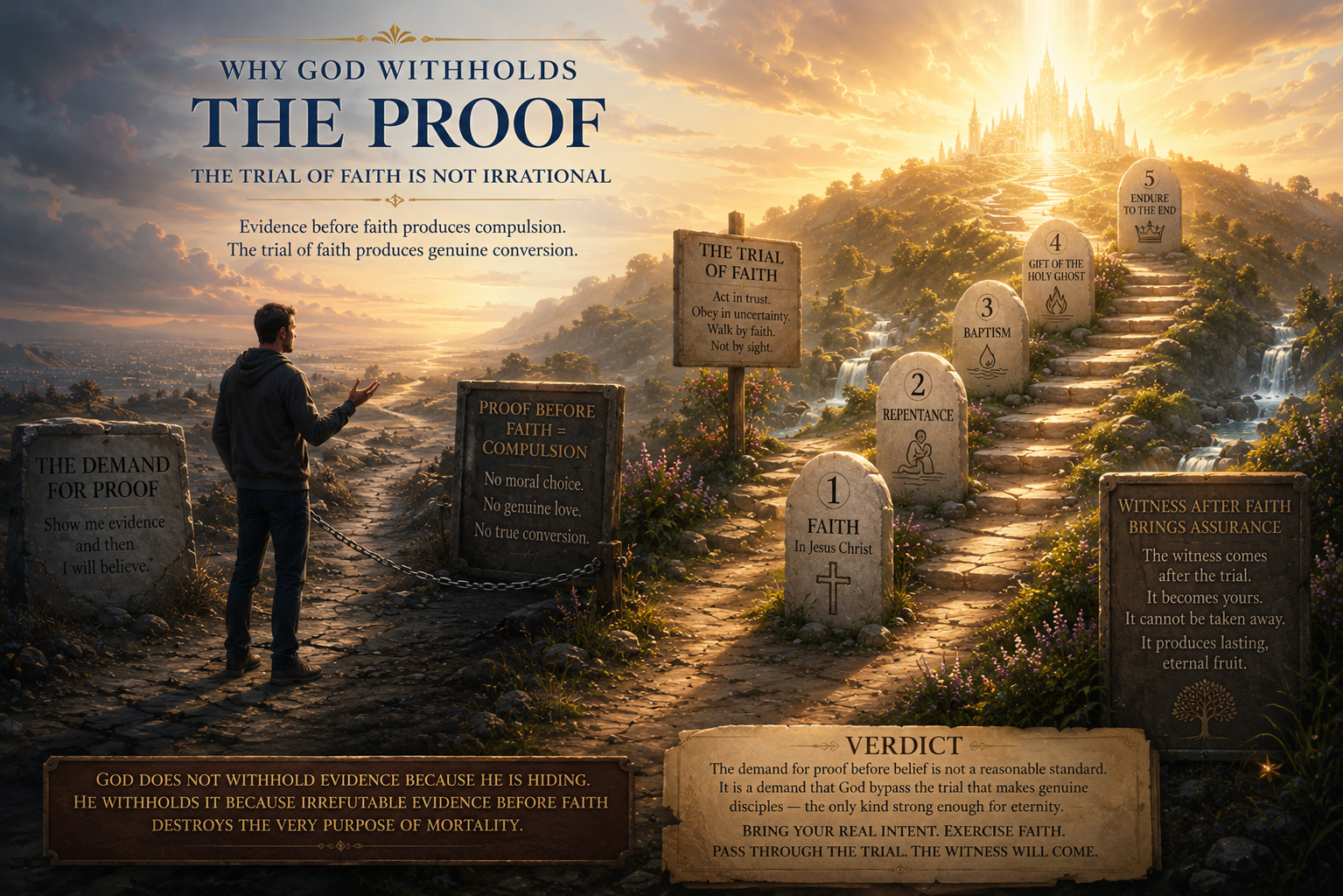
Why God Withholds the Proof — The Trial of Faith Is Not Irrational
The critic demands evidence before belief. But evidence given before faith doesn’t produce faith — it produces compulsion. And a compelled choice is not a moral choice.
The Critic’s Demand
State the objection charitably, because it deserves the courtesy. The critic says: “Show me empirical evidence for the existence of God, for the truth of the gospel, for the validity of your religious claims, and I will believe. Until then, I have no rational obligation to accept what cannot be demonstrated.”
This sounds like a reasonable epistemological position. It is the standard we apply to scientific claims. We do not believe in quantum entanglement because it feels true; we believe in it because experimental evidence supports it. Why should claims about God be held to a lesser standard? Shouldn’t the most important truth claim in human history meet the highest burden of proof?
The argument is clean, confident, and wrong. Here is why.
Why God Cannot Meet It Without Destroying Agency
The demand for evidence before faith is not a neutral epistemological position. It is a demand that God bypass the only conditions under which genuine moral accountability is possible.
Consider what happens if God provided irrefutable empirical proof of His existence and the truth of the gospel. Not a feeling. Not a spiritual impression. Not a coincidence that could be explained away. Irrefutable. Undeniable. Demonstrated to the same standard as laboratory physics.
At that point, rejection of the gospel is no longer a failure of information. It becomes an act of deliberate rebellion against known truth. The stakes for everyone who hears the evidence and rejects it are catastrophically higher. The condemnation is not ignorance — it is defiance. And defiance against certain, proven divine truth is a damnation of a different and more severe order than the damnation of someone who simply never encountered sufficient evidence.
More fundamentally: a choice made under compulsion is not a moral choice. If the existence of God is as undeniable as the existence of gravity, then “choosing” to follow Him is no more morally meaningful than “choosing” not to step off a cliff. The choice must be real. The uncertainty must be real. The faith must be genuinely exercised before the confirmation arrives. This is why Ether 12:6 is not a trick or a design flaw:
“And now, I, Moroni, would speak somewhat concerning these things; I would show unto the world that faith is things which are hoped for and not seen; wherefore, dispute not because ye see not, for ye receive no witness until after the trial of your faith.”
You receive no witness until after the trial of your faith. This is the structural requirement for genuine agency. It is not arbitrariness. It is the only design that makes a free moral choice possible at all. Before faith is exercised and tested, evidence is a sign. A sign given before faith leads to condemnation, not salvation, because it bypasses the process that produces real conversion. The difference between a sign and evidence of faith is precisely the timing: a sign comes before the trial; evidence comes after. One produces compulsion; the other produces strength.
The Pattern in Scripture
Scripture repeats this pattern without exception. The Abrahamic covenant was not given before Abraham proved himself. He was told to leave his homeland, to sacrifice his son, to act in obedience long before the covenant was sealed. The evidence came after the trial.
Thomas demanded proof. He got it.
“Except I shall see in his hands the print of the nails… I will not believe… Then saith he to Thomas, Reach hither thy finger, and behold my hands… be not faithless, but believing… Thomas, because thou hast seen me, thou hast believed: blessed are they that have not seen, and yet have believed.”
Jesus did not rebuke Thomas for doubting. He gave Thomas the evidence he demanded. But He declared a superior state: those who have not seen and yet have believed. Not because evidence is bad, but because faith exercised without compulsion produces a stronger, more permanent, more morally genuine conversion than faith produced by force of irrefutable proof.
Now consider Laman and Lemuel. They saw angels. They heard the voice of the Lord. They had undeniable experiences that no critic could wave away as wishful thinking or self-deception. And they still rebelled. Evidence without a changed heart produces nothing permanent. The problem was never evidence. The problem was that they had not genuinely exercised faith and submitted their will. The signs came before the trial, and instead of producing faith, they produced nothing lasting at all.
The Lord tested Abraham in Abraham 3:25–26: “And we will prove them herewith, to see if they will do all things whatsoever the Lord their God shall command them; And they who keep their first estate shall be added upon.” The proving is not punitive. It is formative. A soul that has not been tested by genuine uncertainty has not yet developed the capacity to hold eternal truth. The trial builds what nothing else can build.
The Epistemology of Faith
The demand for empirical evidence before belief is not a universal epistemological standard. It is the standard appropriate to one domain — empirical science — applied inappropriately to another. We do not evaluate love by empirical measurement. We do not evaluate moral truth by laboratory experiment. We do not evaluate the meaning of suffering by peer-reviewed study. Different domains of truth require different epistemological tools.
Moroni 10:3–5 is not a feeling test. It is a protocol with specific preconditions: ponder the mercy of God, ask in the name of Christ, ask with a sincere heart, with real intent, having faith in Christ. The result is not emotional warmth. The result is knowledge — communicated through the Holy Ghost, which is the Spirit of truth. As D&C 93:36 states: “The glory of God is intelligence, or, in other words, light and truth.”
This epistemological system is not irrational. It is a different epistemological system — one that requires the seeker to bring something to the table. Effort. Sincerity. Real intent. Obedience. A willingness to act before the certainty arrives. That requirement is not a bug. It is the precise feature that makes the resulting knowledge genuinely formative rather than merely coercive.
Religious faith comes through the trial of faith — and then evidence is given to strengthen it. That evidence is not transferable. It cannot be handed from one person to another as proof. It is personal and direct. A spiritual witness cannot be turned into a laboratory result because it was given to a specific soul in response to that soul’s specific exercise of agency. To demand that the evidence be externalizable and publicly reproducible is to demand that God abolish the conditions that make genuine agency possible.
Verdict
The demand for evidence before faith is not a reasonable epistemological standard. It is a demand that God destroy the conditions required for genuine moral accountability. It is a demand that He bypass the trial of faith that produces the only kind of conversion strong enough to survive eternity.
The trial of faith is not a design flaw. It is the design. It is the only system that simultaneously preserves moral agency, makes genuine conversion possible, and produces souls capable of bearing the weight of eternal truth. God does not withhold evidence because He is hiding. He withholds it because irrefutable evidence given before faith does not produce faith — it produces compulsion. And compelled obedience is not the kind of obedience that exalts.
The critic who demands proof before belief has not found a flaw in the gospel. He has found its most important feature and called it a problem. The gospel responds: bring your real intent, your sincere heart, your willingness to act. Exercise faith. Pass through the trial. The witness will come — not before, but after. And it will be yours in a way that no externally imposed proof ever could be.