Sola Scriptura: The Doctrine That Destroys Itself
How Protestant Christianity built its house on a foundation it borrowed from the Church it rejected.
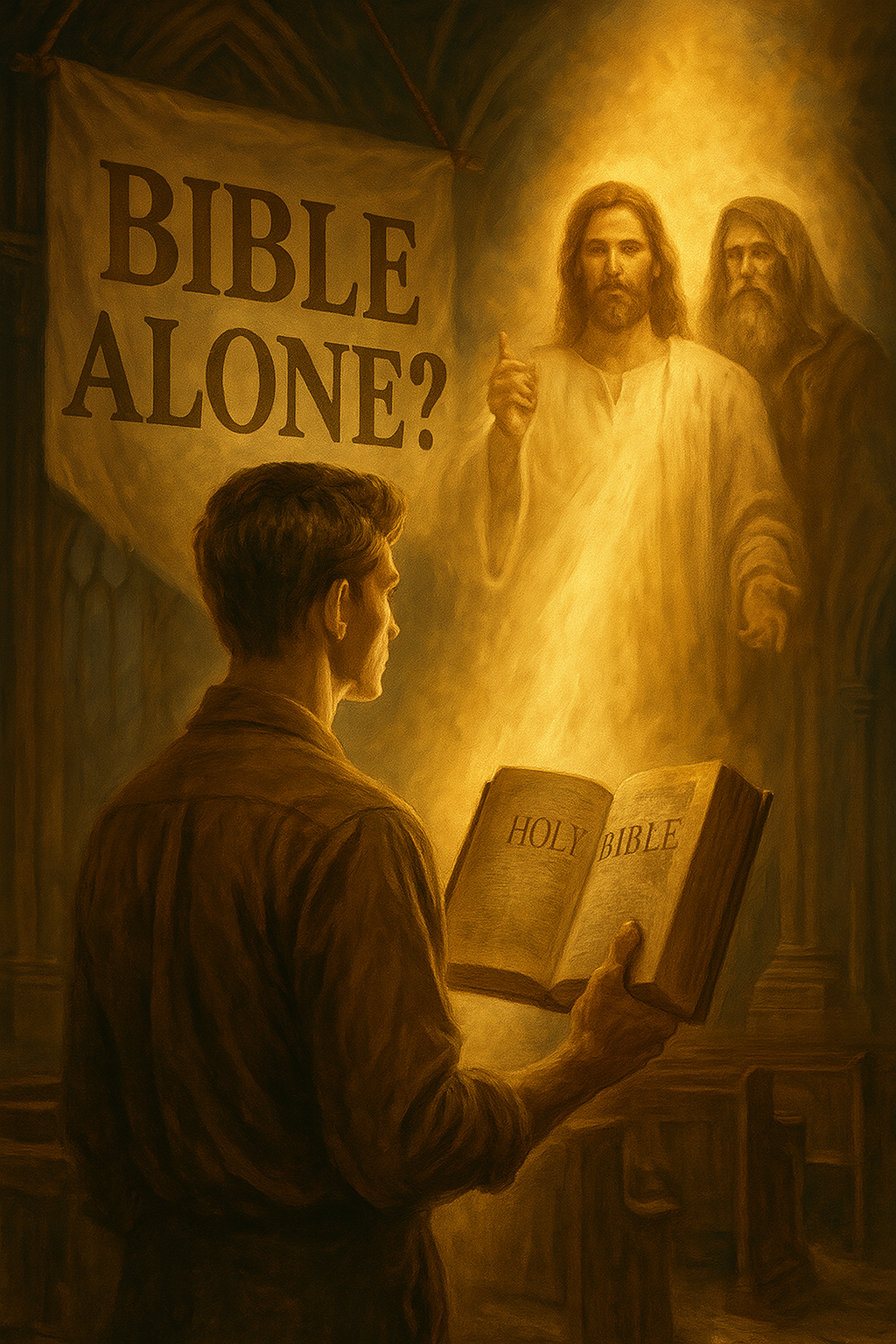
The Claim and Its Fatal Problem
Sola Scriptura — “Scripture alone” — is the cornerstone doctrine of Protestant Christianity. It holds that the Bible is the sole, sufficient, and final authority in all matters of faith and practice. No pope. No council. No tradition. Scripture alone.
It sounds principled. It sounds humble. It sounds like a defense of God’s word against human corruption.
It is none of those things. It is a self-refuting doctrine that collapses the moment you ask the most basic question: which scripture? Assembled by whom? Authorized by what? The answer to every one of those questions is: the Catholic Church. And that answer destroys the doctrine entirely.
Sincerity does not equal correctness. Many hold Sola Scriptura with genuine love for God. That love is not in question. The doctrine is.
Three Problems Sola Scriptura Cannot Solve
Before examining the historical and biblical record in detail, it is worth stating the three core structural problems that Sola Scriptura cannot resolve no matter how ably its defenders argue. These are not peripheral objections. They are foundational failures.
Problem 1 — The Canon Was Not Self-Assembling
The New Testament canon did not exist as a defined collection until the Council of Carthage in 397 AD — over 360 years after Christ. The earliest Christians had no “Bible” in the Protestant sense. For three centuries, the Church debated which books were scripture, operating on living authority: apostles, prophets, bishops, and councils.
Someone had to decide which books were scripture. That someone was the institutional Church — bishops, councils, tradition. The same authority Protestants reject as fallible and corrupt is the authority that handed them their Bible. You cannot trust the canon while distrusting the canonizers.
Problem 2 — The Bible Explicitly Authorizes Non-Biblical Revelation
Hebrews 1:1–2 opens by declaring that God “spake in time past unto the fathers by the prophets” and “hath in these last days spoken unto us by his Son.” The Bible records God speaking through living authorities — prophets, apostles, the Son himself — and nowhere claims to be the final and complete deposit of all possible revelation. 1 Corinthians 14:29–32 assumes that prophets are actively speaking in the assembled church. Ephesians 4:11–13 commands the church to maintain apostles and prophets “till we all come in the unity of the faith.”
We have not reached that unity. By the Bible’s own standard, the offices must still exist. A God who promised ongoing revelation cannot logically be confined to a closed canon.
Problem 3 — Protestants Use Post-Biblical Creeds
The Nicene Creed (325 AD), the Chalcedonian Definition (451 AD), the Westminster Confession (1646), the Augsburg Confession (1530) — none of these are in the Bible. Not a word. Yet Protestant theology is built on these documents. Pastors are required to affirm them. Ordination is withheld from those who reject them.
A tradition that claims “scripture alone” while requiring extra-biblical creedal statements to define its core doctrine has already abandoned its own principle — in practice, before the debate even begins. The church that assembled the canon cannot logically be subordinate to it, and the tradition that depends on post-biblical creeds cannot honestly claim to stand on scripture alone.
The Bible Does Not Teach Sola Scriptura
Begin with the obvious: the Bible nowhere teaches Sola Scriptura. Not a single verse asserts that Scripture is the only source of divine authority. The verse most commonly cited — 2 Timothy 3:16–17 — says Scripture is “profitable” for doctrine. Profitable. Not exclusive. Not final. Not the only channel of revelation.
The early Church had no New Testament. It ran entirely on living authority — apostles, prophets, and revelation. Ephesians 4:11–14 describes the Church as built on apostles, prophets, evangelists, pastors, and teachers — not a text. Ephesians 2:20 is explicit: “built upon the foundation of the apostles and prophets, Jesus Christ himself being the chief corner stone.”
Paul did not tell the Thessalonians to consult scripture alone. He commanded them to hold the traditions delivered both in writing and by spoken word:
“Therefore, brethren, stand fast, and hold the traditions which ye have been taught, whether by word, or our epistle.”
Christ himself promised that the Spirit would continue to reveal things not yet written:
“Howbeit when he, the Spirit of truth, is come, he will guide you into all truth: for he shall not speak of himself; but whatsoever he shall hear, that shall he speak: and he will shew you things to come.”
A God who promised ongoing revelation cannot logically be confined to a closed canon. And the verse most often used to “close the canon” — Revelation 22:18 — explicitly refers only to the book of Revelation itself, not to a Bible that did not yet exist as a collected volume. Using it to close the entire canon is an act of eisegesis, not exegesis.
The doctrine Protestants impose on the text is not found in the text.
The NT Canon Did Not Exist Until the Church Created It
Here is the historical fact that every Sola Scriptura proponent must answer: the 27-book New Testament canon that Protestants treat as their sole authority did not exist in that form until the late 4th century. It was not a document handed down from heaven. It was assembled, debated, and canonized by a church — the Catholic Church — over the course of three centuries.
For the first three centuries of Christianity, the Church used a wide variety of texts. The Marcionite canon (mid-2nd century) accepted only a truncated Luke and ten Pauline epistles. The Muratorian Fragment (late 2nd century) listed a different collection. The Peshitta — the Syriac New Testament — omitted 2 Peter, 2 and 3 John, Jude, and Revelation entirely. Origen, Eusebius, and Athanasius each described different sets of “accepted” books. There was no single authoritative text.
The 27-book canon received its first formal ecclesiastical recognition at the Council of Hippo (393 AD) and was ratified at the Council of Carthage (397 AD). These were Catholic councils operating under episcopal authority, conciliar tradition, and the weight of oral transmission. Jerome’s Vulgate — the authoritative Latin Bible of the Western Church — was produced between 382 and 405 AD under the direct commission of Pope Damasus I.
The question Sola Scriptura cannot answer is this: by what authority did those councils decide which books were scripture? They did not use scripture alone — that would be circular. They used episcopal succession, oral tradition, liturgical use, and the discernment of the Church as a living body under divinely-authorized leadership.
The Church preceded the Bible. The Church produced the Bible. The Church authorized the Bible. Sola Scriptura cannot stand on a foundation it is simultaneously trying to demolish.
Post-Biblical Creeds: The Doctrine Protestants Practice but Won’t Admit
Every major Protestant denomination confesses creeds and doctrinal standards that do not appear in the Bible. The Nicene Creed (325 AD), the Apostles’ Creed (developed 2nd–4th centuries), and the Westminster Confession of Faith (1646) are treated as binding theological authorities across Reformed, Presbyterian, Anglican, and Lutheran traditions. Pastors are required to affirm them. Ordination is withheld from those who reject them.
None of these documents are in the Bible. Not a word of them.
The Trinity doctrine as formally confessed — “one substance, three persons,” derived from the Greek homoousios — does not appear in scripture. The word homoousios is not in the Bible. The formula “God in three persons” is not in the Bible. It was defined at the Council of Nicaea in 325 AD using Greek philosophical vocabulary drawn from Neoplatonism — a conceptual framework the apostles never employed and would not have recognized.
This is not an attack on Trinitarianism as a concept. It is an observation about intellectual honesty: if Scripture alone is sufficient to establish all doctrine, the precise Trinitarian formulation of Nicaea should be derivable from Scripture alone, without the philosophical superstructure of a 4th-century church council. It is not. And every Protestant who confesses the Nicene Creed is implicitly admitting it.
The Westminster Confession goes further still — 33 chapters of detailed doctrinal exposition on topics including election, covenant theology, the regulative principle of worship, and the nature of saving grace. It is the de facto theological authority of the Reformed tradition. Ask a Presbyterian pastor: if there is a conflict between your reading of Scripture and the Westminster Confession, which wins? The answer in practice is always the Confession.
Sola Scriptura is the stated doctrine. Extra-biblical tradition is the practiced doctrine. The gap between what Protestants say and what they do is the proof that the doctrine does not work.
The Logical Kill Shot
Here is the argument that has no answer:
The church that defined the canon cannot logically be subordinate to it.
The Bible did not fall from heaven pre-bound. It was assembled, debated over centuries, and canonized by church leaders who exercised authority and relied on tradition to make those decisions. That process is either legitimate or it is not.
If the authority of the early Church was legitimate — if those councils at Hippo and Carthage had genuine divine guidance in selecting the canon — then the same Church’s authority in other matters cannot be dismissed. You cannot credit the Church with giving you an authoritative Bible while simultaneously rejecting the authority of the Church that gave it to you.
If that authority was not legitimate — if those councils were in error, corrupted, or without divine sanction — then the canon they produced is equally suspect. If you distrust the Church, you have no grounds to trust the canon the Church selected. The books of Hebrews, James, Revelation, and 2 Peter were all disputed. Luther himself called James “an epistle of straw.” By what authority did the Protestant Reformers retain James while rejecting the authority of the councils that preserved it?
You cannot build the house and then demolish the foundation. You cannot use the Catholic Church’s canon while rejecting Catholic authority. The position is incoherent. It has always been incoherent. The Reformers knew it, and they never resolved it.
Is God Still Speaking?
Sola Scriptura implies that God stopped speaking. That the heavens closed after the Apostle John died on Patmos. That revelation — the defining feature of every covenant relationship God has ever established with His people — simply ended, by divine decree, somewhere around 100 AD.
But scripture says otherwise:
“Surely the Lord God will do nothing, but he revealeth his secret unto his servants the prophets.”
“And it shall come to pass in the last days, saith God, I will pour out of my Spirit upon all flesh: and your sons and daughters shall prophesy, and your young men shall see visions, and your old men shall dream dreams.”
“My sheep hear my voice, and I know them, and they follow me.”
Christ said His sheep hear His voice. Not His printed text alone. His voice. The New Testament does not describe a Church sustained by memory and reading — it describes a Church led by revelation, governed by apostolic authority, and guided by the Holy Ghost in real time.
A God who is “the same yesterday, and today, and forever” (Hebrews 13:8) does not speak through prophets for four thousand years and then go permanently silent. That is not the God of the Bible. That is a theological fiction invented to justify a particular 16th-century reform movement.
The Proof Is in the Fragmentation
If Sola Scriptura worked — if the Bible were truly self-interpreting, sufficient, and clear enough to serve as the sole authority for all Christian doctrine — we would expect Christians who held it to converge on a single understanding over time.
The opposite has happened. Since the Reformation, Protestant Christianity has fractured into hundreds of distinct ecclesiastical traditions and dozens of major families — Lutheran, Reformed, Anglican, Baptist, Methodist, Pentecostal, and on. They share the same Bible. They confess Sola Scriptura. They cannot agree on baptism, the Eucharist, predestination, eternal security, church governance, spiritual gifts, the Sabbath, or the age of the earth — among hundreds of other doctrines. (One often hears that there are “40,000 denominations,” but that widely disputed figure is a per-country tally that counts one global communion separately in each country and lumps in Catholics, Orthodox, and others; see the Gordon-Conwell Center for the Study of Global Christianity and this explainer on how the counting works. The honest picture — hundreds of traditions and dozens of families — is more than enough.)
Each tradition believes its interpretation is correct. Each uses the same Bible to arrive at contradictory conclusions. Each effectively makes its own tradition the final arbiter of scriptural meaning — which is precisely the problem Sola Scriptura was supposed to solve.
The fragmentation is not incidental. It is the inevitable result of eliminating authoritative interpretation while insisting the text is self-evident. Every individual becomes his own pope. Every congregation becomes its own magisterium. And the Body of Christ fractures without end.
The Restoration of Apostolic Authority
The Gospel of Jesus Christ was never designed to be transmitted through a book alone. Christ established apostles with authority — living men commissioned to act in His name, to bind and loose, to ordain, to govern, and to receive revelation. He did not establish a printing press. He did not hand the keys of the kingdom to a library.
“And I say also unto thee, That thou art Peter, and upon this rock I will build my church; and the gates of hell shall not prevail against it. And I will give unto thee the keys of the kingdom of heaven: and whatsoever thou shalt bind on earth shall be bound in heaven: and whatsoever thou shalt loose on earth shall be loosed in heaven.”
Keys. Authority. Binding and loosing. These are not literary metaphors — they are the vocabulary of priesthood power conferred on living men. When that authority was lost in the Apostasy, the consequence was not just theological confusion. It was the loss of the very mechanism by which truth is authoritatively declared and covenants are validly performed.
The same apostolic authority that produced the New Testament was rejected in the Great Apostasy — and the consequence is exactly what we see: hundreds of competing traditions, divided into dozens of irreconcilable families, who cannot agree on what their shared scripture means, because they have no authorized interpreter and no living prophet to ask.
What the Gospel of Jesus Christ teaches is that heaven is not silent. That authority was restored. That apostles and prophets were called again. That the pattern Christ established — living men with living keys, receiving living revelation — was not a first-century anomaly but the eternal order of God’s kingdom.
The Verdict
Sola Scriptura is not a biblical doctrine. It is not a historical doctrine. It is a 16th-century polemical invention that has never been coherently practiced by anyone who professes it.
It depends on a canon assembled by a church it rejects. It confesses creeds produced by councils it dismisses. It produces fracture, contradiction, and interpretive chaos wherever it is applied. And it silences a God who never agreed to be silent.
The Bible is the word of God. It is true, it is precious, and it bears powerful witness of Jesus Christ. But the Bible itself — read honestly, in its own historical context — does not teach that it is the only word of God, the final word of God, or a substitute for the living authority Christ personally established.
Read it again. Follow it where it actually leads.
It leads to prophets. It leads to apostles. It leads to a living Church led by a living God who still speaks, still calls, and still covenants.
The heavens are open.
The word is alive.
The covenant is extended.
Sola Scriptura was never the answer. It was always the obstacle.
Appendix — A Reader’s Defense of Sola Scriptura, and Our Reply
A reader submitted the most articulate defense of Sola Scriptura we typically encounter. It deserves a full answer. Below is his argument as he framed it, followed by a point-by-point reply.
The Defense, As Submitted
The Objection
“Sola Scriptura does not mean Christians reject all authority except the Bible, nor that the church has no role in preserving or recognizing Scripture. It means Scripture alone is the only God-breathed, infallible, final authority over the church. Every other authority — pastors, councils, traditions, churches — is subordinate to and corrected by Scripture.
You say the doctrine collapses when someone asks ‘which Scripture? assembled by whom? authorized by what?’ But those questions confuse recognizing authority with creating authority. The church did not create Scripture any more than Israel created the Old Testament prophets. Romans 3:2: ‘they were entrusted with the oracles of God.’ Israel recognized the inspired writings but did not create them; the church recognized the apostolic writings but did not give them authority. Scripture was authoritative the moment God inspired it.
Ephesians 2:20 says the church is ‘built on the foundation of the apostles and prophets, Christ Jesus Himself being the corner stone.’ The foundation creates the church; the church does not create the foundation. 2 Timothy 3:16–17 teaches sufficiency: Scripture equips the man of God for every good work — so no additional infallible authority is necessary alongside it.
You argue Sola Scriptura is self-refuting because the Bible contains no inspired table of contents. But that proves too much: there is also no inspired list of which councils are infallible or which traditions are binding. The canon was not arbitrarily invented; the early church recognized books with apostolic authority, doctrinal consistency, and marks of inspiration. A jeweler recognizes a diamond by its inherent qualities; he does not create it by recognizing it.
Jesus affirmed Scripture’s supreme authority — Matthew 4:4 (‘every word that proceeds out of the mouth of God’), John 10:35 (‘the Scripture cannot be broken’), and Mark 7:6–13, where He rebuked leaders for ‘invalidating the word of God by your tradition.’ The Bereans (Acts 17:11) were commended for examining the Scriptures to test even Paul. Scripture repeatedly warns against adding to God’s word — Deuteronomy 4:2, Proverbs 30:5–6, Revelation 22:18–19.
The church is called ‘the pillar and support of the truth’ (1 Timothy 3:15) — but a pillar supports something greater than itself. The church serves the truth; it does not create it. Christians believe the Bible is Scripture because God inspired it, not because a church later granted it authority. ‘My sheep hear My voice’ (John 10:27). Therefore Sola Scriptura remains the biblical position.”
It is a careful argument. It fails at every step. Here is the answer, in his own order.
1. The redefinition moves the problem; it does not solve it
Granting that Sola Scriptura means “Scripture is the only infallible, final authority” only relocates the difficulty. Which Scripture? The Protestant 66-book canon, the Catholic 73-book canon, the Eastern Orthodox 76-book canon, or the Ethiopian Tewahedo 81-book canon? Each claims to be God’s word, and by Sola Scriptura’s own logic no church or council may authoritatively settle the dispute — so the slogan has no fixed referent. Worse: the defender concedes that pastors, councils, and his own interpretation are all fallible. The route from God’s infallible word to the believer’s actual belief therefore runs entirely through fallible channels — fallible canon recognition, fallible translation, fallible exegesis. The infallibility exists in principle and never once reaches the believer.
2. “Recognition, not authorization” — the diamond analogy refutes itself
A diamond has objectively measurable physical properties; no jeweler disputes what counts as a diamond. The canon was disputed for centuries. Hebrews, James, 2 Peter, 2 and 3 John, Jude, and Revelation are the antilegomena — the “spoken-against” books. Some early lists excluded them; some early lists included the Shepherd of Hermas, the Didache, and 1 Clement. Athanasius’s 367 AD list — the first matching the modern Protestant New Testament — came three centuries after Christ. Luther wanted James, Hebrews, Jude, and Revelation removed. Diamonds are not debated; the Christian canon was, for 300 years, by an authoritative body issuing binding decisions. Recognition was an exercise of authority. The analogy proves the opposite of what it intends.
3. Romans 3:2 and Ephesians 2:20 describe authority through living men, not a book
The defender’s own proof texts cut against him. Romans 3:2 says Israel was “entrusted with the oracles of God” — oracles delivered through prophets and preserved by an authoritative covenant people with priests, a high priest, and a council. That is revelation through an authorized channel, not Scripture floating free of any institution. And Ephesians 2:20 says the church is “built upon the foundation of the apostles and prophets, Jesus Christ himself being the chief corner stone.” The foundation is apostles and prophets — living men bearing prophetic authority. The cornerstone is Christ Himself — a Person, not a text. Paul confirms it in 2 Thessalonians 2:15: hold the traditions “whether by word, or our epistle.” Oral and written, equal weight, both apostolic. That is not Sola Scriptura.
4. 2 Timothy 3:16–17 does not say what the defense needs it to say
When Paul wrote “all scripture is… profitable” (c. 67 AD), the New Testament did not yet exist as a canon — he refers primarily to the Old Testament. On the defender’s reading, the Old Testament alone “thoroughly equips the man of God,” which would mean no Christian ever needed the New Testament. The verse proves too much. The Greek ōphelimos means profitable, useful — not sufficient or exclusive. “Equips” is what tools do for a carpenter; they do not exhaust what he needs to work. And one verse earlier (2 Timothy 3:14) Paul anchors Timothy in “the things which thou hast learned… knowing of whom thou hast learned them” — the authority of Paul’s own oral instruction, and the faith of Lois and Eunice (2 Timothy 1:5). Oral tradition is the foundation; Scripture is the complement, not the replacement.
5. The “table of contents” objection is not escaped by turning it around
Yes — the Bible also contains no inspired list of which councils are infallible. Correct, and irrelevant. That observation only damages systems that require such a list from Scripture alone. The Latter-day Saint, Catholic, and Orthodox positions do not need an inspired biblical table of contents because they hold that living prophetic authority can settle these questions. Sola Scriptura uniquely demands the canon be self-contained in Scripture, because by its own logic no other authority is permitted to settle it. Turning the objection around does not escape it — it exposes that the defender, too, relies on extra-biblical authority (the Reformation’s ratification of the 66-book canon). He simply will not admit it.
6. The Bereans disprove Sola Scriptura; they do not support it
In Acts 17:11 the Bereans tested Paul’s preaching against the Scriptures — the Old Testament, the only Scripture they had. They were checking a living apostle’s new revelation against the prophecies of Christ, and they accepted it and were converted. That is the Latter-day Saint pattern exactly: existing scripture confirms new revelation through an authorized servant. By the Sola Scriptura model the Bereans should have told Paul, “show us this in Moses or we will not believe.” They did not. They received his apostolic word as the word of God.
7. The “warnings against adding” self-refute under consistent application
Apply the defender’s logic consistently. If Deuteronomy 4:2 (“ye shall not add unto the word”) forbids all further scripture, then Joshua, Judges, Samuel, Kings, Isaiah, Jeremiah, and every prophet through Malachi violated it — and the entire New Testament is unbiblical. The same applies to Proverbs 30:5–6 after Solomon. And Revelation 22:18–19 refers to the book of Revelation, which was not yet bound into any canon when John wrote it. These three passages share one formula and each applies to a specific text; what they forbid is human tradition falsely claiming divine authority, not further divine revelation through prophets. Read as the defender reads them, no scripture should exist after Deuteronomy 4.
8. Christ’s use of Scripture is not an endorsement of Sola Scriptura
Matthew 4:4 — “every word that proceedeth out of the mouth of God” — uses a present participle that affirms continuing revelation, not a closed past-tense text. In John 10:35 Christ affirms Scripture’s reliability while interpreting it on His own authority — “ye have heard that it was said… but I say unto you.” And in Mark 7:6–13 He rebukes corrupt tradition (corban) that nullified God’s commandment — not tradition as such. Paul commands the holding of apostolic tradition (2 Thessalonians 2:15; 3:6; 1 Corinthians 11:2). To fold all tradition into the Pharisaic category is precisely the move Christ did not make.
9. “The pillar and ground of the truth” indicts the doctrine it is cited to defend
In 1 Timothy 3:15 Paul calls the church — not the Bible, not the canon — “the pillar and ground of the truth.” A pillar holds up the roof; without it the roof falls. That is a relationship of necessary support, not of inferior dignity; the defender is smuggling a hierarchy into the metaphor that the metaphor does not contain. The verse declares that the institutional, apostolic body of Christ is what God established to bear and defend the truth in the world. It is among the strongest scriptural statements against Sola Scriptura, not for it.
10. The question the doctrine cannot survive: where was it before 1517?
If Sola Scriptura is the apostolic position, it should be found in the early Church. It is not. Irenaeus (Against Heresies, c. 180 AD) teaches the opposite: “we should not seek among others the truth which we can easily obtain from the Church, since the apostles deposited in her, as in a rich treasury, all things pertaining to the truth” (3.4.1). Tertullian, Athanasius, Cyril, Chrysostom, and Augustine all affirm the authority of apostolic succession and tradition alongside Scripture. None of them teaches Sola Scriptura. The doctrine was introduced by Luther in the sixteenth century. For more than three hundred years the Christian church had no agreed New Testament canon and was still the Body of Christ — which means, on the Sola Scriptura model, that the early Saints had no infallible authority at all. That is not historically defensible.
11. “My sheep hear my voice” — and the fragmentation answers the defense
The defense closes with John 10:27: “My sheep hear my voice.” Indeed they do — His voice, not His printed text alone. And if Sola Scriptura truly let the sheep hear that voice clearly in the text, it would not have splintered Protestantism into hundreds of distinct traditions and dozens of major families, all reading the same Bible and contradicting one another on baptism, the Eucharist, salvation, church government, and the nature of God. Either the sheep are not hearing, or the system does not deliver what it promises. Paul’s charge in 1 Corinthians 1:10 — “that ye all speak the same thing, and that there be no divisions among you” — is the precise opposite of what five centuries of Sola Scriptura have yielded.
12. The pattern Christ actually established
Scripture is true, authoritative, and inspired. The Restoration does not weaken it — it adds to it, because God has not stopped speaking. The alternative the defender fears — “some human institution standing above Scripture” — is a false dichotomy. The Gospel of Jesus Christ does not place men above the word of God. The real alternative is the apostolic pattern Christ Himself established and never disestablished:
Three Sources, One Voice
- Scripture — Old Testament, New Testament, Book of Mormon, Doctrine and Covenants, Pearl of Great Price.
- Living apostles and prophets — the New Testament pattern, restored.
- The Holy Ghost — confirming truth to the seeker (Moroni 10:3–5; 1 Corinthians 2:10–14; John 14:26; 16:13).
All three speak with one voice because all three come from one God. None overrides another. The system Christ built is not a book — it is a church: apostles, prophets, Scripture, sacraments, and the Spirit, all working together “till we all come in the unity of the faith” (Ephesians 4:13). Sola Scriptura broke that unity. The Restoration restored it.
Bottom Line
Your defense is the best version of an indefensible doctrine. It cannot account for its own canon. It misreads its foundational verse. Its “warnings against adding” self-refute. It contradicts the unanimous testimony of the early Fathers. And it has produced exactly the fragmentation Paul forbade in 1 Corinthians 1:10. Where is Sola Scriptura in Irenaeus? In Athanasius? In Augustine? Until you can point to it, the doctrine is what it has always been — a 16th-century slogan, refuted by Scripture, by history, and by the state of every body that has tried to live by it.
God speaks — past, present, and future — through Scripture and through the prophets and apostles He established and never withdrew. The Bible says so. The Fathers said so. Christ said so. Which one will you trust?