
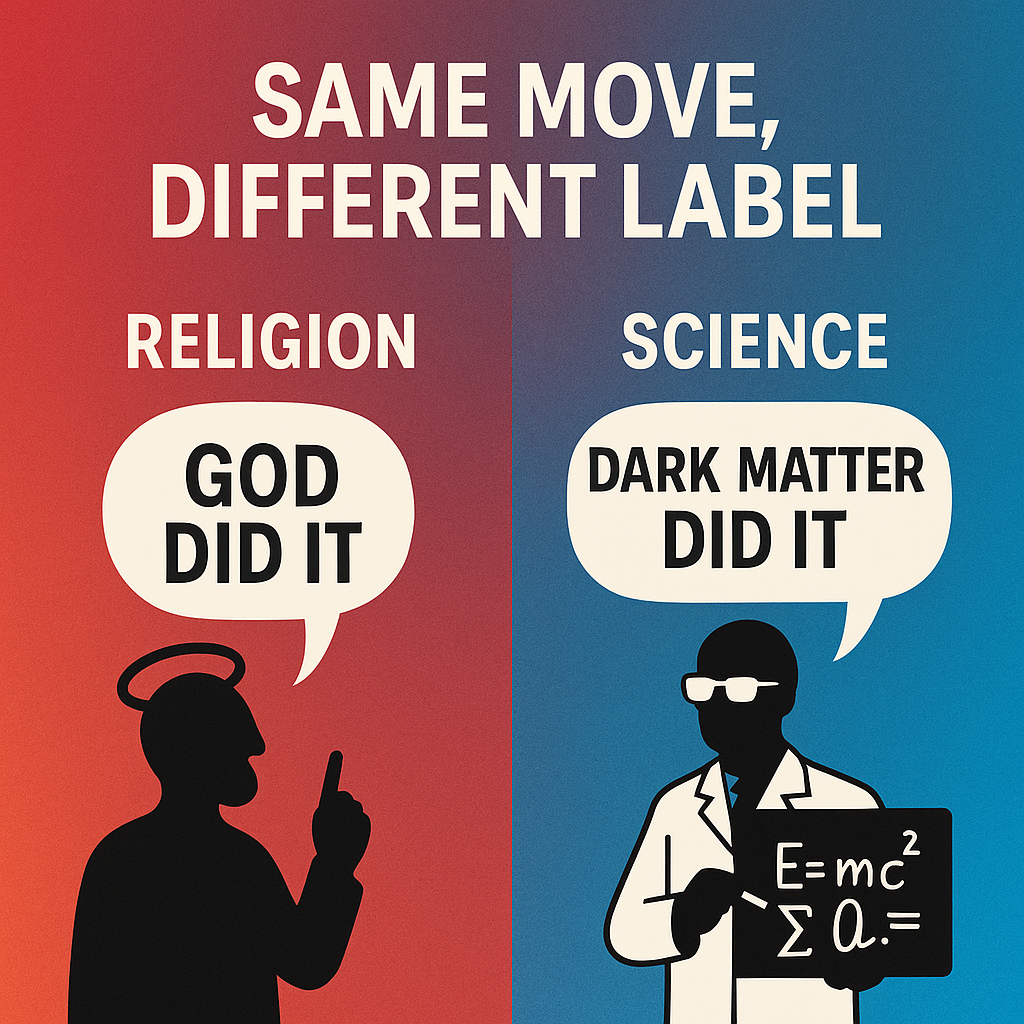
God Did It — And So Did Dark Matter
Why the skeptic’s favorite taunt exposes his own double standard.
Atheists sometimes snicker that believers “wave their hands and say God did it” whenever the facts run thin. Yet modern science often performs the same sleight-of-mind—christening an enigma with a technical name and then talking as if the name were knowledge. The parallel becomes clearest once we remember that, in the restored gospel, “It is impossible for a man to be saved in ignorance” (D&C 131:6). “God did it” is therefore not a period but a question-mark: an invitation to seek revelation from a being whose civilization so far exceeds ours that our familiar measures of technological advancement—such as the Kardashev scale—hardly begin to describe it.
The Rename-and-Rest Gambit on Both Sides
-
Dark matter. Galaxy discs spin fast enough to tear themselves apart, so cosmologists posit an invisible mass halo and go hunting through giant xenon vats. After five decades, every detector—including 2024’s record-sensitive LZ run—has come up empty. We still have a word, not a mechanism.
-
Dark energy. Type-Ia supernovae appear too dim, implying cosmic expansion is accelerating. The label “dark energy” stuck—and fresh DESI data now hints that the effect may even be weakening, underscoring that nobody yet knows what the “energy” is.
-
Emergence. When higher-level order (from wetness to consciousness) pops out of lower-level parts and no reduction works, the puzzle is baptized “an emergent property.” Critics note that this label too often merely confesses ignorance and takes pride in it.
The underlying pattern is identical:
The Pattern
Gap → Label → Provisional comfort.
Until someone uncovers how the thing works, the noun is a politely wrapped question mark.
Why the Parity Holds
-
Both paths treat the label as a launching pad.
Scientists design ever-wider detectors; disciples seek higher revelation. Neither camp means to stop at the name. -
Both require trust beyond direct sight.
A cosmologist trusts untested equations; a believer trusts unseen heavenly beings. Each wagers that deeper investigation—empirical or revelatory—will pay off. -
Both update or abandon the placeholder when richer light arrives.
Capture a WIMP tomorrow and “dark matter” graduates to mechanism; receive clearer revelation and yesterday’s folk theology retires. Restored scripture revels in that progression: “Whatever principle of intelligence we attain unto … will rise with us.” (D&C 130:18–19.)
Answering Common Objections
“Science is falsifiable; revelation isn’t.”
Spiritual investigation does set tests—ask, seek, knock; by their fruits ye shall know—just not with photomultiplier tubes. The domains differ; the logical role of a stand-in label does not.
“Scientific placeholders come with numbers.”
True, and prophetic placeholders come with covenants. Both let practitioners act, measure consequences, and refine their models of reality.
The Restoration Cosmology
The skeptic sometimes objects that believing in God is no different from believing in the ancient gods of thunder or luck—a gap-filler promoted by fear. The Restoration dissolves that objection entirely by giving the gap a face, a history, and a trajectory.
God is not a lonely self-caused abstraction suspended in philosophical ether. He is an eternal being who existed before this universe’s spacetime, who grew, developed, and ascended through the same process He now offers to us. To borrow a loose analogy from speculative cosmology: physicist Nikolai Kardashev’s original 1964 scale ranked civilizations by their command of energy in only three tiers—Type I (planetary), Type II (stellar), and Type III (galactic) (see Kardashev scale). Higher tiers such as a “Type IV” or “Type V” are not part of Kardashev’s scale at all; they are later, purely speculative thought-experiments proposed by others, not established physics. Yet even those imagined extremes—a society of exalted intelligences commanding energy and order at cosmological scales, architects of reality itself—only gesture, faintly, toward what the restored gospel describes. Such beings created with purpose and reason the conditions in which our universe could unfold, so that beings like them could one day grow, progress, and share in their glory.
This reframes the fine-tuning argument entirely. A true engineer does not assemble every molecule by hand. He sets conditions, establishes laws, and lets the system unfold. God’s greatness is not that He micromanages, but that He orders creation so perfectly—calibrating the gravitational constant, the cosmological constant, the mass ratio of proton to electron—that physics and biology accomplish His designs without His constant interference. The finely tuned laws are not evidence against a creator; they are the signature of a master architect.
This is the grand vision the Restoration contributes that no other tradition matches in its clarity: life and matter were organized for a purpose—to empower, to perfect, to create beings in the image of those who came before. This is not drift; this is design. The plan of salvation is not a local policy for one small planet; it is the operating logic of the cosmos. We are like them, in embryo.
“Whatever principle of intelligence we attain unto in this life, it will rise with us in the resurrection. And if a person gains more knowledge and intelligence in this life through his diligence and obedience than another, he will have so much the advantage in the world to come.”
The Verdict
Whether the blank is filled with “God,” “dark matter,” or “emergence,” the human move is the same: we meet mystery, coin a term, then pursue further light. Labels are linguistic life-rafts that keep inquiry afloat until the shoreline of explanation appears. Recognizing that parity does not belittle either enterprise; it simply reminds us—scientist or saint—to stay humble, keep experimenting, and never confuse a convenient noun with understanding.
Thus, the skeptic who scoffs that “God-talk is just superstition” while happily leaning on words like dark matter or emergence is sawing off the very branch he’s sitting on. Both moves admit a gap, baptize it with a label, and trust that deeper work will someday fill in the mechanism. Calling one maneuver “irrational faith” and the other “hard science” is therefore not a principled distinction but a rhetorical convenience—an intellectual double standard that lets the atheist enjoy his own placeholders while mocking everyone else’s.
Recognizing the symmetry doesn’t settle which worldview is true, but it does expose the charge of “superstition” as hypocrisy, not argument. And when that charge collapses, what remains is a cosmos ordered by intelligence, a plan extending across worlds, and an invitation to become what God already is.