
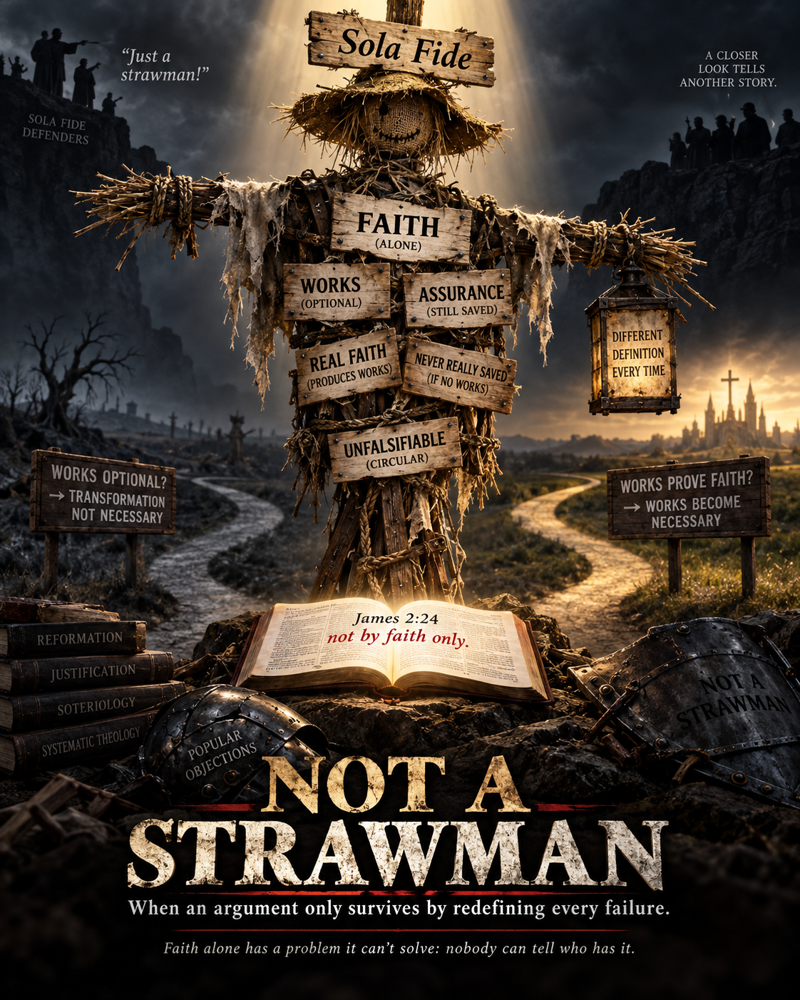
The Happy-Thought Gospel — Sola Fide Is Not a Straw Man
“Have a happy thought, then live however you want.” Evangelicals call that a caricature of faith alone. It is the doctrine — stated by their own societies, their own seminaries, their own confessions, and their own founder. Here it is from their side first, then from the scriptures, then from the federal data.
Start With Your Own Sentence
The standard Evangelical formula runs like this: we are justified by God’s grace through faith in Christ, apart from works. Read the last three words again, for that is the moment of justification, and by the formula’s own account it happens before a single work exists. So what does the justified man have at that instant, standing there justified with nothing yet done? A belief, a moment, a happy thought — and nothing else, because nothing else has been allowed to exist yet.
The formula then adds that this faith “does not remain alone” — works will follow. But that is a prediction about what comes later, not a condition of what already happened, and if the works never come the justification has already occurred regardless. Nobody caricatured anything; that is simply the formula with the clock run forward. Faith alone plus “works will follow” is still faith alone, for the works were declared unnecessary to the saving before they were ever asked to appear.
Whether that is really what Evangelicals teach, or only what an outsider can squeeze out of their wording, is a fair thing to ask — so let them answer.
The People Who Say It Out Loud
The Grace Evangelical Society was founded in 1986 and is still active. Its stated purpose sits on its own homepage: God offers “the free gift of everlasting life through faith in the Lord Jesus Christ, apart from works done before or after the new birth” (faithalone.org). Before OR after, in their own sentence, on their own masthead, and not a Latter-day Saint paraphrase of anything.
That position came out of Dallas Theological Seminary. Not a cult. A seminary. Zane Hodges (Absolutely Free!, 1989) and Charles Ryrie (So Great Salvation, 1989) — dispensational, thoroughly Protestant, nobody’s idea of a fringe — built it against John MacArthur’s The Gospel According to Jesus (1988). This is MacArthur himself describing what Hodges taught: “you can be an unbelieving believer, he said; you can deny Christ and still go to heaven” (Ligonier, 5 Minutes in Church History).
Notice where that fight happened: inside the Evangelical camp, about the Evangelical doctrine, between men who agreed entirely on faith alone and disagreed only on whether faith alone lets you live however you want. The Christian Research Institute’s own summary of the controversy says it plainly: “Neither side is saying that salvation is by works. Both affirm the clear teaching of Scripture that salvation is a gift freely given by God to man” (Lyle, CRI). One side said yes, in print, and is still saying it today.
So when an Evangelical calls “happy thought, then live however you want” a straw man, whom is he calling a straw man? A whole wing of his own movement, with a homepage and a publishing arm and forty years of books.
Luther Said It First
Go back to the source, for the Reformer himself wrote it down in a letter to Melanchthon on August 1, 1521, four years into the Reformation:
Luther’s Works, vol. 48, pp. 281–282
“Be a sinner and sin boldly, but believe and rejoice in Christ even more boldly, for he is victorious over sin, death, and the world.”
“No sin will separate us from the Lamb, even though we commit fornication and murder a thousand times a day.”
Same letter. A few lines apart (full passage). Defenders say he was exaggerating to make a point about grace, and perhaps he was — but what was the point? That no amount of sin, however bold, can touch the standing of the one who believes, which is the happy-thought gospel in the founder’s own hand.
Once Saved, Always Saved — In the Confession
The Baptist Faith and Message 2000, Article V, is the confession of the largest Protestant body in America. Those God has accepted in Christ “will never fall away from the state of grace.” Believers “may fall into sin through neglect and temptation” and yet “shall be kept by the power of God through faith unto salvation” (bfm.sbc.net).
Now put the two pieces together — justified apart from works, and cannot be lost — and ask what that combination logically permits. Any life whatsoever. Whether a given Evangelical personally lives that way is irrelevant, for most do not and I am glad of it; the DOCTRINE allows it, which is all I ever said, and it is exactly what the Grace Evangelical Society says on purpose.
This site has a whole page on what this category becomes in practice: the carnal Christian, a saved man who lives like an unsaved one, invented to absorb the contradiction.
How Do You Know You’re Saved?
Here is the question the doctrine cannot answer. The Evangelical says works are the evidence that faith is real. Very well — then until the works show up, can anybody tell a saved man from a happy-thought man? No, and not the man himself, not his pastor, not his wife, for they look identical because at the moment of justification they ARE identical: one belief, one moment, zero works.
Yet the same Evangelical claims to KNOW he is saved, right now, on the strength of the faith moment. Pick one. Either assurance comes from faith alone, in which case the works are optional and you may live however you want, or assurance waits on the works, in which case the works are a condition of salvation — which is James’s point, and mine. There is no third door, and John closed it himself: “hereby we do know that we know him, if we keep his commandments. He that saith, I know him, and keepeth not his commandments, is a liar” (1 John 2:3–4). The apostle locates assurance in obedience, and the doctrine locates it in the moment, and those are two different places.
And when the works never do show up? Every Evangelical reaches for the same rescue: he was never really saved. Think about what that does to the claim, for if every absence of fruit gets reclassified as absence of faith, then “genuine faith always produces works” is no longer a statement about the world at all — it is a definition, immune to any evidence that could ever be brought against it. Does anyone know if a man’s faith was fake or not? No one can tell, and the doctrine is built so that no one ever will. A doctrine that survives only by declaring its failures invisible has not passed the Matthew 7:16 test. It has refused to take it. And a movement whose own soteriology is unfalsifiable is in no position to announce that the Latter-day Saints are not saved.
The Data, Since the Faith “Produces” Obedience
The claim is testable, so test it with the best behavioral data there is rather than with anecdotes. David Ayers of Grove City College — an Evangelical, writing for the Institute for Family Studies in 2019 — ran the federal National Survey of Family Growth and the General Social Survey (Ayers, “Sex and the Single Evangelical”).
Ayers, IFS, 2019 — NSFG 2013–17 and GSS 2008–18
- Roughly two-thirds of Evangelical young people in the NSFG had engaged in sexual intercourse.
- 86% of never-married Evangelical women and 82% of men had at least one sexual partner since age 18.
- Only 37% of “fundamentalist” adults said sex outside marriage is “always wrong”; 41% said “not wrong at all.”
- Weekly attenders (ages 18–22) drop to 51%.
At the level of profession, Evangelical behavior tracks the general population. The gap opens up only where there is ongoing practice — attendance, devotion, the lived works of religion — so that the one variable that moves behavior is the one variable the doctrine calls unnecessary to salvation. The faith did not produce the obedience; the works did.
The full numbers, the Latter-day Saint comparison, and the ten strongest objections are on their own pages: Sola Fide’s Fruit — The Statistical Record and Objections Answered.
On Your Verses — Paul Abolished Circumcision, Not Conditions
Romans 3:28, Romans 4:5, Ephesians 2:8–9. What are the “works of the law” Paul sets aside? The Mosaic ceremonial law, and Paul tells you so himself: “Circumcision is nothing, and uncircumcision is nothing, but the keeping of the commandments of God” (1 Corinthians 7:19). The ritual is nothing while the commandments still bind, and the same apostle with the same pen wrote all of the following:
Paul on conditions
- Romans 2:13 — “the doers of the law shall be justified.”
- Philippians 2:12 — “work out your own salvation with fear and trembling.”
- 1 Corinthians 9:27 — “lest that by any means, when I have preached to others, I myself should be a castaway.”
- Galatians 5:19–21 — they which do the works of the flesh “shall not inherit the kingdom of God.”
Could Paul himself be a castaway? He thought so, or he would not have disciplined his body to avoid it. Can a man who does the works of the flesh inherit the kingdom? Paul says no. So did Paul abolish conditions? He abolished circumcision, and that is all he abolished.
The Word That Isn’t There
The doctrine is named for the word “alone.” That word is in no Greek manuscript of Romans 3:28. Luther put it in his 1522 German New Testament, and when he was challenged he admitted it in his 1530 Open Letter on Translating:
Luther, Open Letter on Translating (1530)
“I also know that in Rom. 3, the word ‘solum’ is not present in either Greek or Latin text — the papists did not have to teach me that — it is fact! The letters s-o-l-a are not there.”
“If your Papist wishes to make a great fuss about the word ‘alone’ (sola), say this to him: ‘Dr. Martin Luther will have it so…’ Sic volo, sic iubeo, sit pro ratione voluntas. (I will it, I command it; my will is reason enough.)”
Read it yourself (CCEL). He goes on to argue that German idiom demands the word. Maybe it does — but German idiom does not put a word in the Greek, and a doctrine named for a word its founder confessed to inserting has a problem that no grammar lesson fixes.
The phrase “faith only” appears in exactly one verse of the Bible. James 2:24 — and the word in front of it is NOT.
James, Read Plainly
The harmonization says James is fighting “dead, empty profession” and not talking about salvation at all. Read him, because he says what he is talking about in his first sentence. What is his question? “Can faith save him?” (James 2:14). Salvation. Not demonstration. What do works do to faith? “By works was faith made perfect” (2:22). When was Genesis 15’s reckoning of righteousness fulfilled? At Moriah, decades later (2:23).
“Ye see then how that by works a man is justified, and not by faith only.”
Works complete the faith, and that is not a Latter-day Saint gloss laid over the text — it is the text, in the order James wrote it. The verse-by-verse treatment is here: James 2 — Not by Faith Only.
The Verdict
“You don’t need Joseph Smith to get your doctrine from Paul.” Agreed — and you don’t need him to lose it, either. Paul read whole, James read plainly, Hodges and Ryrie read honestly, Luther read in his own letters, and the federal data read without flinching all say the same thing: the faith that saves is the faith that keeps covenant. Faith is the first principle of the gospel and not the last one, for if belief were all that was required, why must anyone obey?
So is “happy thought, then live however you want” a straw man? It cannot be, for a straw man is a position nobody holds, and this one has a society with a homepage, two seminary textbooks, a denominational confession, and a founder’s letter. Everything else is a happy thought with a theological excuse.
Sources: Grace Evangelical Society · Ligonier, MacArthur on the Lordship Controversy · Lyle, “Understanding the Lordship Salvation Controversy,” CRI · Luther to Melanchthon, 1 Aug 1521 (LW 48:281–282) · Baptist Faith and Message 2000, Art. V · Luther, Open Letter on Translating (1530) · Ayers, IFS (2019)